Students of European Ethnology Present Different Perspectives on Protest in Bamberg
Even conceptually, protest is difficult to define as a “richly varied social phenomenon” (Fahlenbrach/Klimke/Scharloth 2016). Protests aim to preserve or improve everyday life. They pursue a range of objectives through various practices. The French Revolution and the “1968 movement,” for example, are often regarded as turning points and are firmly embedded in collective memory as driving forces of social change. By contrast, local and “quiet” forms of resistance often remain in the shadow of grand historical narratives and thus go unnoticed, even though they, too, frequently have lasting consequences.
What exactly is protest? How can protest manifest itself? How does it become visible? Which perspectives come into contact with one another? And what traces does it leave behind?
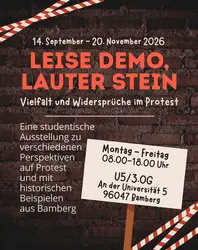
The exhibition “Quiet Demonstration, Loud Stone: Diversity and Contradictions in Protest” (Leise Demo, lauter Stein. Vielfalt und Widersprüche im Protest) offers some answers to these questions. It emerged from the seminar „Dagegen! Historische Proteste in Bamberg kulturanalytisch betrachtet“ (“Against It! A Cultural-Analytical Examination of Historical Protests in Bamberg”) held during the summer semester of 2026 at the Junior Professorship of European Ethnology under the direction of Monika Bäuerlein, M.A., in collaboration with the Bamberg City Archives.The exhibition presents different perspectives on protest while using historical examples from Bamberg to illustrate the many forms protest can take.
Location:Building An der Universität 5 (U5), 96047 Bamberg, corridor outside the European Ethnology rooms on the third floor.
Accessibility: Step-free access via the Burgershof entrance on the west side of the building. The elevator is located to the right in the entrance area.
Exhibition dates and opening hours: Until 20 November 2026, Monday to Friday, 8:00 a.m.–6:00 p.m.