Master’s degree programme in German Studies

Start of study
Winter and summer semester
Regular study period
4 Semester, 120 ECTS credits
International
Stays abroad are possible
Degree
Master of Arts


What makes us special
Here in Bamberg, we’re about more than just ‘good’ literature, ‘correct’ language, old books and new spelling rules!
- We provide in-depth historical and systematic knowledge of the German language and literature from the Middle Ages to the present day.
- In the compulsory elective module, we focus on providing insights into relevant practical and professional fields for German studies graduates – with a free choice of options from the areas of subject didactics, literary education and German as a foreign language.
- We address the expanded media possibilities brought about by digitalisation and social media in our subject, for example, through online teaching programmes (Virtual University of Bavaria), relevant publication formats (e.g. the ‘Live Handbook of Literary Education’ or digital text editions) and as a partner of the longest-established online review forum, literaturkritik.de. We also teach students how to use AI tools critically in research (e.g. automated text recognition) and introduce them to the data- and statistics-based fundamentals of computer-assisted language analysis. As part of our extended programme, we offer, amongst other things, access to digital, research-based teaching and professional development resources via the Digitale Souveränität portal.
- Practical seminars with guest lecturers from the fields of arts and culture journalism, cultural management, editorial work, press and public relations, or publishing law, as well as collaborations with institutions dedicated to promoting and fostering literature (the International Artists’ Residence Villa Concordia, the Literaturhaus München, the Literarisches Colloquium Berlin, E.T.A. Hoffmann Theatre in Bamberg or the Bamberg State Library) provide you with the best possible preparation for your future career.
- In addition to the curriculum, we offer a wide range of events – for example, conferences, readings as part of ‘Literature at the University’, the Bamberg ‘Poetics Professorship’, or events organised by the Centre for Medieval Studies (ZeMas).
- We ensure good opportunities for mutual recognition of German Studies credits within Master’s and teacher training programmes, thereby facilitating a dual degree or a change of degree programme.
The Master’s programme serves as preparation for subsequent doctoral studies at the chairs of German Studies in Bamberg – which are also outstanding in the academic world – and for a subsequent career in research.
Structure of the Master's Degree
You will acquire comprehensive knowledge in all areas of German Studies: linguistics, modern and classical German literature, literary education, language and literature teaching methodology, and German as a foreign language. In addition to broadening your specialist knowledge, you will have the opportunity to set your own personal areas of focus, for example within the ‘Extension’ module. The degree programme also offers the opportunity to study abroad and incorporates practical insights into relevant professional fields into its course offerings. Furthermore, Bamberg offers a wide range of events centred on language and literature, including those outside the regular curriculum.
| Study structure | ECTS credits |
|---|---|
| Modern German Literary Studies | 10 - 30 |
| Medieval German Philology | 10 - 30 |
| German Linguistics | 10 - 30 |
| Subject-specific teaching methodology, or the teaching of literature, or German as a foreign language | 10 |
| Expansion area | 20 |
| Master Thesis | 30 |
Good Reasons to Study with Us
Living internationality in Bamberg
In Bamberg, we strike a balance between a sound academic business studies programme and the development of comprehensive international skills, particularly as part of our integrated study abroad programme. Our graduates are able to operate in an international environment in a goal-orientated manner and successfully deal with specific challenges in multinational companies. With a large number of Erasmus students, a lively student life and visitors from all over the world, Bamberg is an excellent starting point for building your own international network.
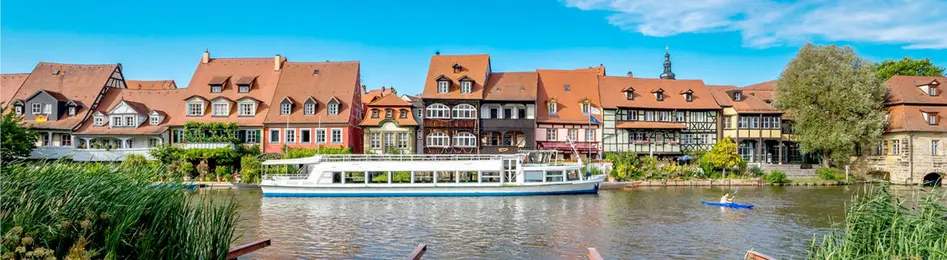
The world heritage site is our campus
Thanks to its historic city centre, which is a UNESCO World Heritage Site, Bamberg is considered one of the most beautiful cities in Germany. With around 80,000 inhabitants and around 10,000 students, Bamberg offers an ideal setting for successful studies with flair.
The attractive location on the edge of Franconian Switzerland also offers a wide range of opportunities for sports and leisure activities to balance out the intensive academic work during your studies. The general advantages of a smaller city should also not be neglected - such as the relatively low cost of living or simply the high level of public safety.
Not least because of the advantages mentioned above, the University of Bamberg is also very popular with foreign students.
Your Qualifications
Prospective students who are foreign nationals and hold qualifications from abroad must apply to the Student Registry to undertake a Master’s degree at the University of Bamberg. The Registry will check whether applicants possess the required university entrance qualification and the necessary level of German language proficiency. The Master’s programme in German Studies requires a very good command of the German language. If applicants have reached language level C1, they will be enrolled on condition that they provide evidence of having completed the module ‘German as a Foreign Language for International Students of German Studies C2’ by the end of the second semester.
Entry requirements
- a completed Bachelor’s degree with a minimum grade of 2.5