
Rights and Licenses When Publishing Open Access
Licenses
Licenses govern the rights of use for your publication. They allow you to specify who may redistribute, modify, or otherwise use your publication, and under what conditions. For initial publications following open-access principles, we recommend the Creative Commons CC BY license.
Regardless of which license you choose, you retain the copyright to your publication. It is inalienable and can only be transferred to third parties by inheritance (Section 29 of the German Copyright Act). As the author, you can decide whether your work should be published at all and who may use it under what conditions.
Copyright is also the basis for VG Wort’s remuneration. You can find more information on this here.
Creative Commons Licenses
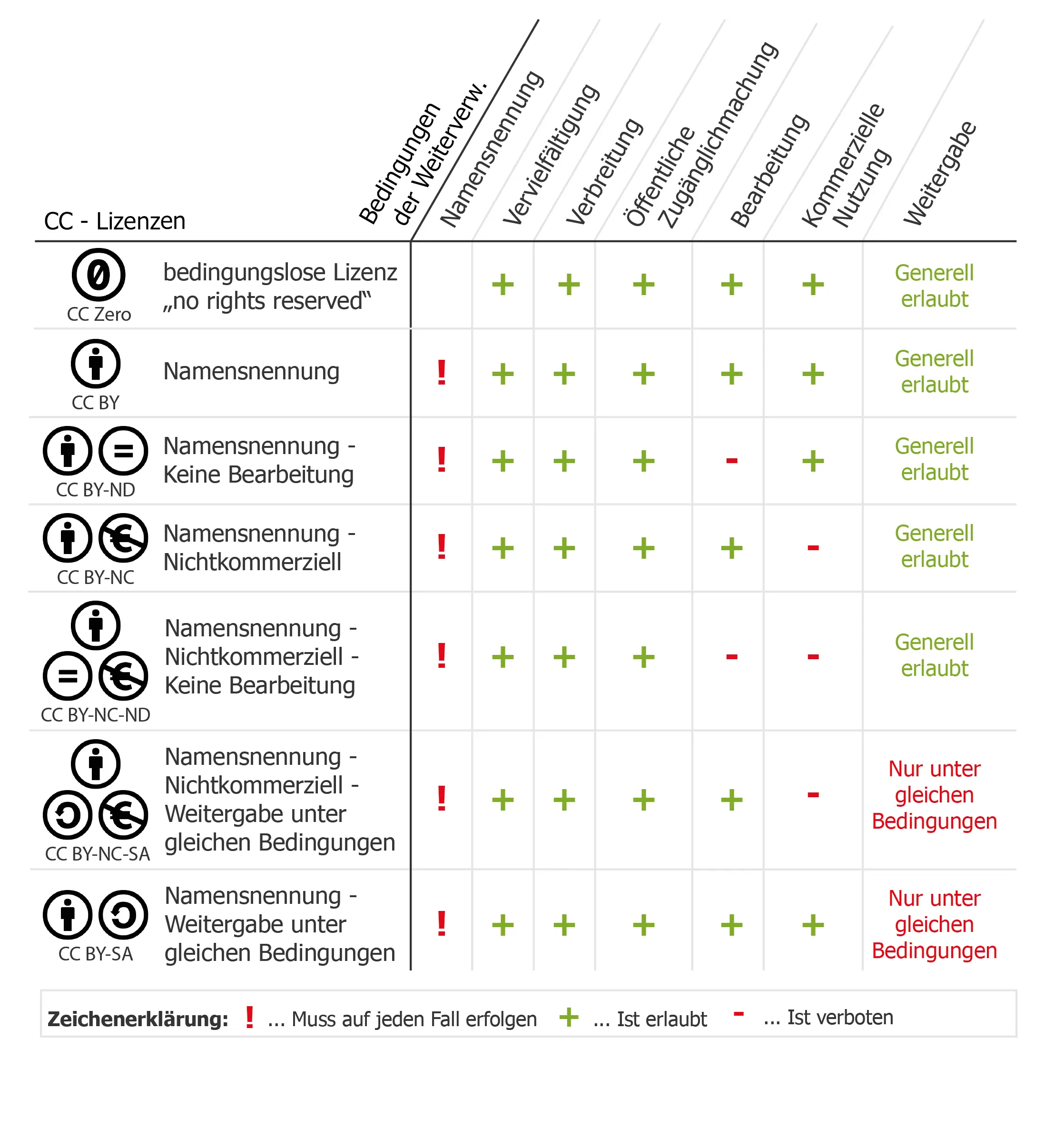
A CC license (Creative Commons license) for a publication allows you to specify how your publication may be distributed and used. You can grant users of your publication far more nuanced rights than those provided for under copyright law. The limitations of copyright law, such as the right to quote, continue to apply regardless of the license under which the work is published.
CC licenses are used internationally and in a standardized manner to break down barriers to the dissemination of knowledge in the fields of research and culture. Granting a CC license provides legal certainty—for both publishers and users. This ensures optimal accessibility and dissemination, particularly for open-access publications. However, only the CC BY and CC BY-SA licenses are considered open-access-compatible. The other CC licenses restrict open-access principles.
If you wish to apply a CC license to your publication, you should consider what is most important to you, such as maximizing distribution, encouraging extensive reuse, or protecting against commercial use. However, regarding non-commercial use, please note that this choice may limit the visibility of your document. This rule also applies to providers of search engines and resource discovery systems. Furthermore, your work cannot be included in non-commercial offerings if a more permissive license is used there (e.g., on Wikipedia, which uses the CC BY-SA license as its standard). Similarly, use in academic blogs is not permitted if they contain advertising.
Why CCBY is the best option for open access publications
- Maximum reuse and distribution: Others may distribute, remix, adapt, and build upon your work, provided that you are credited as the author.
- Equal commercial use for all: What exactly constitutes “non-commercial use” is not clearly defined under German law, which is why non-commercial use is often interpreted very narrowly. By granting permission to everyone, it prevents any single party from profiting from it.
- Consistency with key open access statements: CC BY is consistent with the most important open access statements, e.g., those of research funding agencies.
- Legal clarity: The terms of use are clearly defined and legally unambiguous under CC BY.
More detailed information can be found on the Deal Consortium website.
Germany Copyright Law

German copyright law is considered the “strictest license.” The uses permitted by law are set forth in Sections 44a–63a of the German Copyright Act (UrhG). These include:
- Use for the purpose of quotation (Section 51 UrhG),
- Use for private and other personal purposes (Section 53 UrhG), including reproductions (e.g., copies and printouts), provided they consist of small portions of a published work or individual articles that have appeared in newspapers or magazines,
- Use for educational, scientific, and institutional purposes under certain conditions (Sections 60a–h UrhG).
All other types of use, e.g., adaptations, commercial use, public performance, reproductions, and distribution, are permitted only with the express permission of the author.