
Open Science
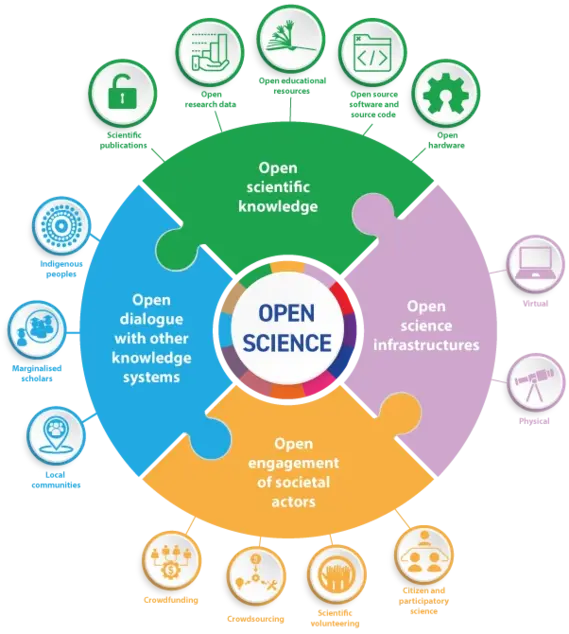
“The term ‘open science’ encompasses […] strategies and procedures that are all aimed at […] making all components of the scientific process openly accessible and reusable via the Internet. The goal is to open up new opportunities for science, society, and the economy in the use of scientific findings.”
translated from: Mission Statement of the German Open Science AG, 2014 (Site in German).
The UNESCO Recommendation on Open Science defines the principles of transparency, reproducibility, reusability, and open communication, as well as equity and sustainability, as the fundamental goals of Open Science.
Open Science contributes to ensuring good scientific practice and enables fair access to knowledge for science and society. The German Research Foundation (DFG) describes Open Science als Teil der Wissenschaftskultur (October 2022, in German).
Open Science an der Universität Bamberg
The University of Bamberg has embedded Open Science in its strategy. The foundation for this was laid as early as 2011 with the adoption of its open access declaration. Since 2004, dissertations, theses, academic monographs, conference proceedings, and secondary publications (preprints and postprints) have been available in Open Access through the university’s institutional repository (FIS).
Between 2021 and 2022, a central research data management service was established, the institutional reserach data repository went online, and the university’s research data policy was published.
On April 25, 2023, the University of Bamberg Press (UBP) celebrated its anniversary: For 15 years, UBP has been publishing according to the principle of Diamond Open Access (definition by the DFG).
In March 2024, the University of Bamberg was among the first signatories of the Barcelona Declaration on Open Research Information. The signatories advocate for freely accessible research information and use systems that support open research information.
The University Library advocates for Open Science and supports researchers in its implementation across various subfields.
Sections of Open Science
Open Access
Open Access means that scholarly publications are available on the internet free of charge and publicly and may be used, copied, distributed, and reproduced without restrictions, provided that the authorship is correctly cited.
The Otto Friedrich University supports Open Access through its Open Access Statement, published in 2011, which is currently being updated.
The University Library offers various services in the area of Open Access publishing.
The University of Bamberg Press publishes works by members of the University of Bamberg. Publications are primarily released online, but also in print. The goal is cost-effective and rapid publication to sustainably showcase the University of Bamberg’s academic achievements to the outside world.
Open Research Data
The term “open data” refers to (research) data that can be freely used and reused without restrictions, potentially under the terms of a free license. The focus is on the accessibility of the data.
The term FAIR data is also frequently used. FAIR data goes beyond open data in that it focuses not only on usage rights but also on technical requirements for data provision. The FAIR Data Principles, which are referenced by research funders among others, describe fundamental aspects that research data must fulfill.
The handling of research data is an important part of good scientific practice. The Central FDM-Service supports you in research data management (FDM)—from planning and applying for a project, through organization, storage, and documentation during the project, to the publication and archiving of your research data at the end of the project. We are available as an advisory service for all members of the university.
The FDM Service is a collaboration between the Office of Research Funding and Transfer (Z/FFT), the University Archives (Z/ARCH), the IT Service (ITS), and the University Library.
In its Research Data Policy, the university provides its researchers with guidelines for handling research data and outlines available support services.
University members can publish their research data in the Institutional research data repository (FD-Repo) .
Bibliographic information about research data can be recorded in the Research Information System (FIS) for inclusion in the university bibliography.
Open Educational Resources (OER)
“Open Educational Resources (OER) are educational materials of any kind and in any medium that are licensed under an open licence. Such a licence allows for free access, as well as free use, adaptation and redistribution by third parties, with no restrictions or only minor restrictions. The creators themselves determine which rights of use they grant and which rights they reserve. Open Educational Resources can comprise individual materials, but also entire courses or books. Any medium can be used. Curricula, course materials, textbooks, streaming videos, multimedia applications, podcasts – all these resources are OER if they are published under an open licence.” (Definition by the German UNESCO Commission, German).
The University’s Media Didactic Service (MD) (German) provides support on issues relating to the development of digitally supported teaching and learning scenarios and the design of digital learning environments.
Open Source
“Open-source software and open-source code generally refer to software whose source code is made publicly available in a timely and user-friendly manner, in a format that is readable and modifiable by both humans and machines, under an open licence […]” (UNESCO Recommendation on Open Science 2021).
The University Library relies on open-source software in the following areas:
- Reference Management: Zotero is a free, open-source reference management programme for collecting, managing and citing various sources.
- Library Management System: With FOLIO, the University Library uses an open-source library system to manage all library processes, such as the licensing and acquisition of digital and printed literature, the provision of digital and analogue books and media, the funding of Open Access, and much more.
- Literature Research (Bamberger Catalogue): VuFind serves as the interface for the Bamberg Catalogue and provides various search functions.
- Resaarch Information system (FIS): The Bamberg FIS is operated and further developed on the basis of the open-source software DSpace-CRIS.
- Publication of Open Access Journals: Using Open Journal Systems (OJS), the University of Bamberg Press offers a platform for the operation of open-access journals.
Open Peer Review
Open peer review is an umbrella term for various methods that make the traditional peer review process, a classic form of quality control for academic publications, more open.
Traditional single-blind or double-blind procedures have come under criticism as they are time-consuming and can lead to unfair publication processes. To counteract this, open peer review emphasises transparency. For example, the identities of authors and reviewers can be disclosed to all parties involved. Furthermore, it is possible to publish the reviews alongside an article.
Further information (German) is available from the German-language Open Science AG.
Open Abstracts
Abstracts summarise the content of academic publications, improve discoverability and spark readers’ interest in the full text.
Many abstracts are already available in various bibliographic databases, but often with limited access options, for example because a subscription is required or the abstracts cannot be processed automatically.
The University Library supports the free availability of abstracts. Freely accessible abstracts from the FIS are thus passed on to Crossref, and conversely, open abstracts provided by Crossref are integrated into the FIS.
Further information is available on the websit of the Initiative for Open Abstracts.
Open Citations
Citations are a key element of academic discourse, literature reviews and bibliometrics. Citations make the substantive relationships between academic publications transparent.
Freely available citation data improves the transparency and accessibility of research and makes it easier to find research outputs such as publications, data or software.
The university press UBP works with the open-source software Open Journal Systems, which allows journals to use Open Citations via a plug-in.
Further information is available on the webiste of the OpenCitations project.
Open Research Information
By signing the Barcelona Declaration on Open Research Information, the University of Bamberg supports the principle that, in addition to research results and research data, all relevant research information should be open and freely accessible to everyone.
Research information refers to bibliographic metadata – such as titles, authors and abstracts of publications – as well as metadata on the software and other tools used. Information on funding bodies, projects, institutions, awards and research profiles is also included.
Research information plays a crucial role in the evaluation of researchers and institutions, in the allocation of resources, and in the discoverability of scientific results. At present, research evaluation still relies heavily on closed infrastructures – the openness of research information is of crucial importance for transparent and fair research evaluation. The Coalition for Advancing Research Assessment (CoARA) – a global alliance of research institutions and organisations – is commited to initialising a cultural shift in research assessment, moving towards qualitative assessment through peer review and the responsible use of quantitative indicators.
The Research Information System FIS – the institutional repository and university bibliography – lists the publications of members of Otto Friedrich University of Bamberg and links them to projects and departments.
In the FIS, university members can:
- Publish documents in open access – provided there are no legal obstacles (institutional repository)
- Submit publications and research data (university bibliography)
Theses may also be published in the FIS under certain conditions.
Open Methodology
In order to understand and reproduce scientific findings, a complete description of the methods, procedures and tools used in the research process is essential. This includes, for example, a detailed description of study designs, data collection tools, analytical methods and materials used, ideally prior to the start of data collection through pre-registration or the publication of study protocols. By openly sharing the methodology used, other researchers are enabled to understand, replicate and apply studies to their own research questions. Open Methodology makes a significant contribution to quality assurance in science.
Citizen Science
Citizen science involves members of the public actively participating in research projects. They are often involved in collecting, researching, measuring and analysing data. Citizen science represents a form of lifelong learning and science communication.
Further informationen is available from the German Open Science AG.