
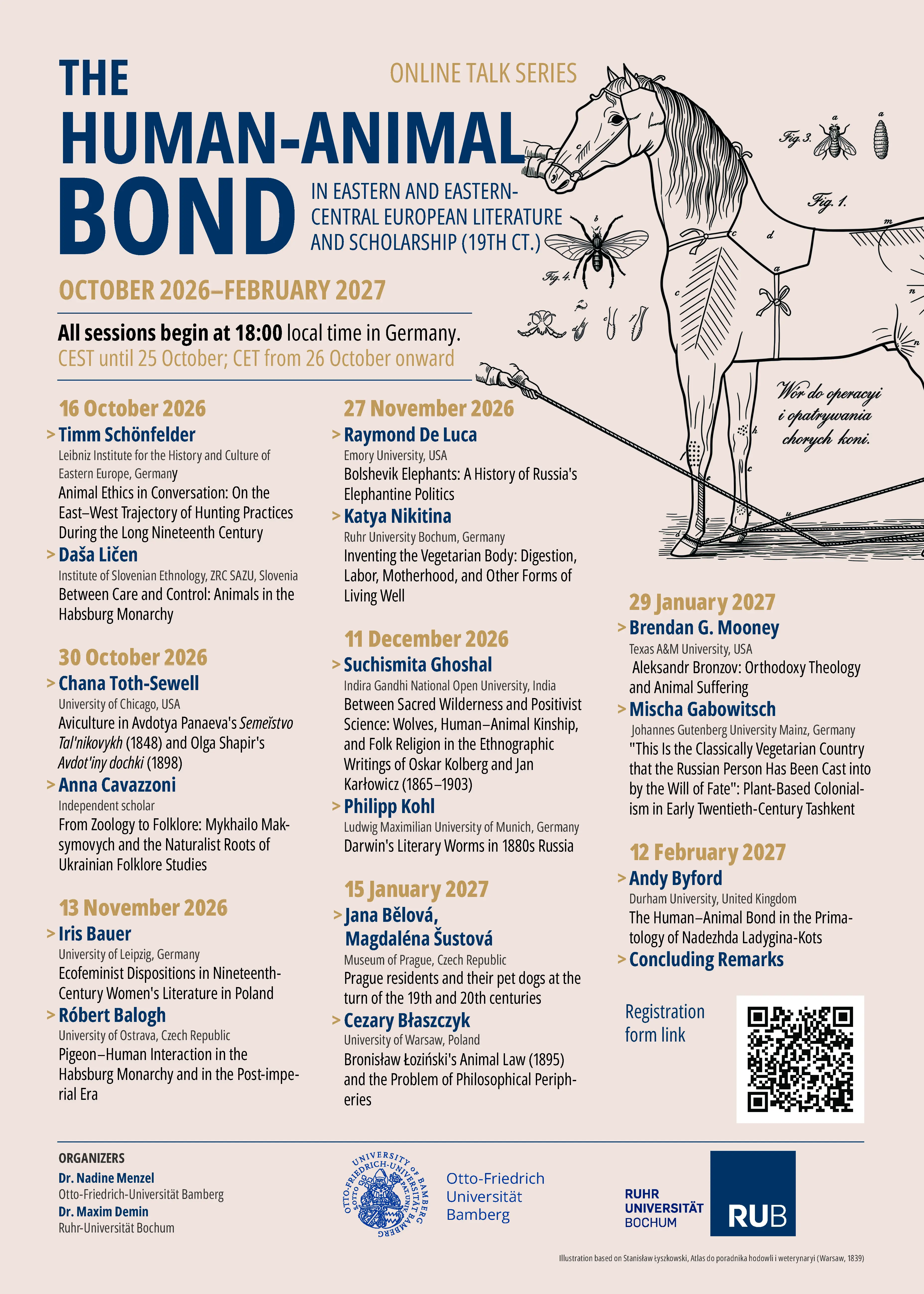
International Online Lecture Series “The Human-Animal Bond in Eastern and Eastern-Central European Literature and Scholarship (19th ct.)”
What role did animals play in the emergence of modern conceptions of nature, knowledge, and humanity?
During the Long 19th Century – from the late 1700s to World War I – the relationship between humans and animals underwent a fundamental transformation. Animals were not only a source of food, a labor force, and the subject of scientific research, but also increasingly became the focus of ethical, philosophical, and literary debates. Questions of consciousness, suffering, dignity, and agency took center stage, as did the question of what actually distinguishes humans from animals.
This lecture series explores these developments in Eastern and Central Eastern Europe, particularly within the context of the Russian, Habsburg, and Ottoman Empires. Through the interplay of religion, the natural sciences, medicine, philosophy, and literature, new conceptions of animals and the relationship between humans and nature emerged. The influence of evolutionary theories and modern science increasingly challenged the notion that humans stand outside or above nature.
Contributions from literary studies, philosophy, the history of science, and cultural history offer diverse perspectives on an era in which the modern understanding of nature, knowledge, and humanity underwent a decisive transformation.
The lectures will take place online every other Friday starting October 16, 2026.
The zoom-link to participate will be sent out to you after registering via:
https://docs.google.com/forms/d/e/1FAIpQLSefrwK555XhWDMW_PbR3EEGFo-dviCopTSPcFsRE-Z97OhJAA/viewform

Program:
16 October 2026
Timm Schönfelder (Leibniz Institute for the History and Culture of Eastern Europe, Germany)
Animal Ethics in Conversation: On the East–West Trajectory of Hunting Practices During the Long Nineteenth Century
Daša Ličen (Institute of Slovenian Ethnology, ZRC SAZU, Slovenia)
Between Care and Control: Animals in the Habsburg Monarchy
30 October 2026
Chana Toth-Sewell (University of Chicago, USA)
Aviculture in Avdotya Panaeva's Semeĭstvo Talʹnikovykh (1848) and Olga Shapir's Avdotʹiny dochki (1898)
Anna Cavazzoni (Independent scholar)
From Zoology to Folklore: Mykhailo Maksymovych and the Naturalist Roots of Ukrainian Folklore Studies
13 November 2026
Iris Bauer (University of Leipzig, Germany)
Ecofeminist Dispositions in Nineteenth-Century Women's Literature in Poland
Róbert Balogh (University of Ostrava, Czech Republic)
Pigeon–Human Interaction in the Habsburg Monarchy and in the Post-imperial Era
27 November 2026
Raymond De Luca (Emory University, USA)
Bolshevik Elephants: A History of Russia's Elephantine Politics
Katya Nikitina (Ruhr University Bochum, Germany)
Inventing the Vegetarian Body: Digestion, Labor, Motherhood, and Other Forms of Living Well
11 December 2026
Suchismita Ghoshal (Indira Gandhi National Open University, India)
Between Sacred Wilderness and Positivist Science: Wolves, Human–Animal Kinship, and Folk Religion in the Ethnographic Writings of Oskar Kolberg and Jan Karłowicz (1865–1903)
Philipp Kohl (Ludwig Maximilian University of Munich, Germany)
Darwin's Literary Worms in 1880s Russia
15 January 2027
Jana Bělová, Magdaléna Šustová (Museum of Prague, Czech Republic)
Prague residents and their pet dogs at the turn of the 19th and 20th centuries
Cezary Błaszczyk (University of Warsaw, Poland)
Bronisław Łoziński's Animal Law (1895) and the Problem of Philosophical Peripheries
29 January 2027
Brendan G. Mooney (Texas A&M University, USA)
Aleksandr Bronzov: Orthodoxy Theology and Animal Suffering
Mischa Gabowitsch (Johannes Gutenberg University Mainz, Germany)
"This Is the Classically Vegetarian Country that the Russian Person Has Been Cast into by the Will of Fate": Plant-Based Colonialism in Early Twentieth-Century Tashkent
12 February 2027
Andy Byford (Durham University, United Kingdom)
The Human–Animal Bond in the Primatology of Nadezhda Ladygina-Kots
Concluding Remarks