Design and Summary of Modules
Pursuing the master's degree programme Survey Statistics, 120 ECTS credit points - according to the European Credit Transfer System - must be achieved in compulsory and mandatory modules. Assuming that four semesters are needed to complete the course of studies, students have to attend courses amounting to an average of 30 ECTS points per Semester. One ECTS credit point corresponds to a workload of approximately 30 hours.
| Modulgruppen | ECTS-Punkte |
|---|---|
| Fundamentals | 30 |
| Survey-Statistics | 12 - 30 |
| Data analysis | 12 - 30 |
| Application | 0 - 12 |
| Research and Practice | 0 - 18 |
| Master’s thesis | 30 |
Overview of modules
The Master’s programme comprises 6 module groups:
1. Fundamentals (30 ECTS credits)
The Fundamentals module group includes core modules on statistical methods, statistical programming and statistical machine learning.
2. Survey Statistics (12–30 ECTS credits)
The Survey Statistics module group covers the statistical methodology aspect of the Master’s programme.
3. Data Analysis (12–30 ECTS credits)
In the Data Analysis module group, alongside the development of skills for analysing specific data situations, students also acquire advanced knowledge of the programming languages R and Python. Modules in this group are structured less methodologically than those in the Survey Statistics module group and place a clear emphasis on practical application using concrete data examples.
4. Application (0–12 ECTS credits)
In addition, courses within the ‘Application’ module group offer you the opportunity to acquire interdisciplinary knowledge, build on existing skills or gain an interdisciplinary insight into the competencies of other subjects. Furthermore, additional modules from the ‘Survey Statistics’ and ‘Data Analysis’ module groups may be included.
5. Research and Practice (0–18 ECTS credits)
Within the ‘Research and Practice’ module group, you can consolidate the knowledge you have acquired in an application-oriented manner and gain valuable practical, professional and personal experience. Taking part in a research project or completing a work placement offers the opportunity to gain an insight into future career fields and to establish initial professional contacts.
6. Master’s Thesis (30 ECTS credits)
The Master’s thesis finally rounds off your degree programme. Through the written thesis and the associated colloquium, you are expected to demonstrate your ability to familiarise yourself independently with an interesting problem within a given timeframe, analyse it using academic methods, and discuss the results in written form.
Sample study plans
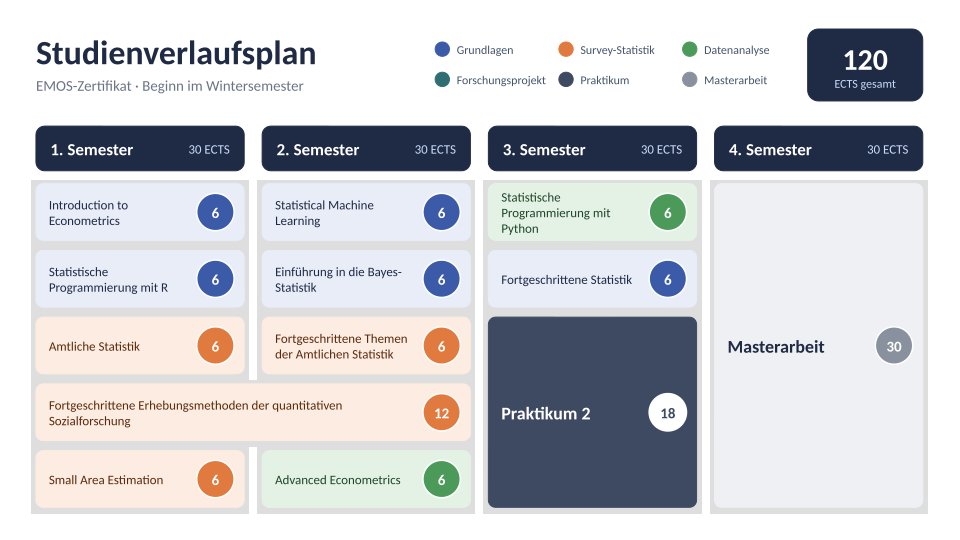
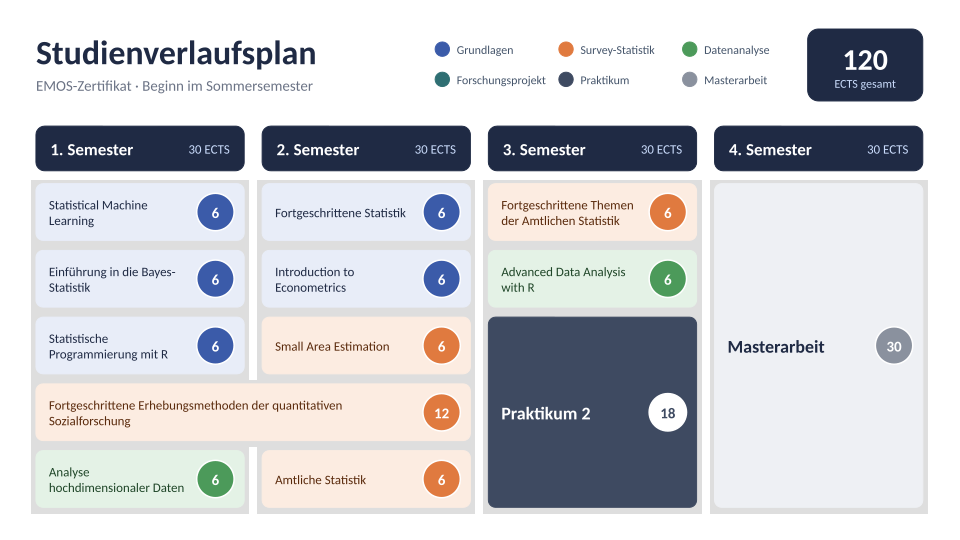
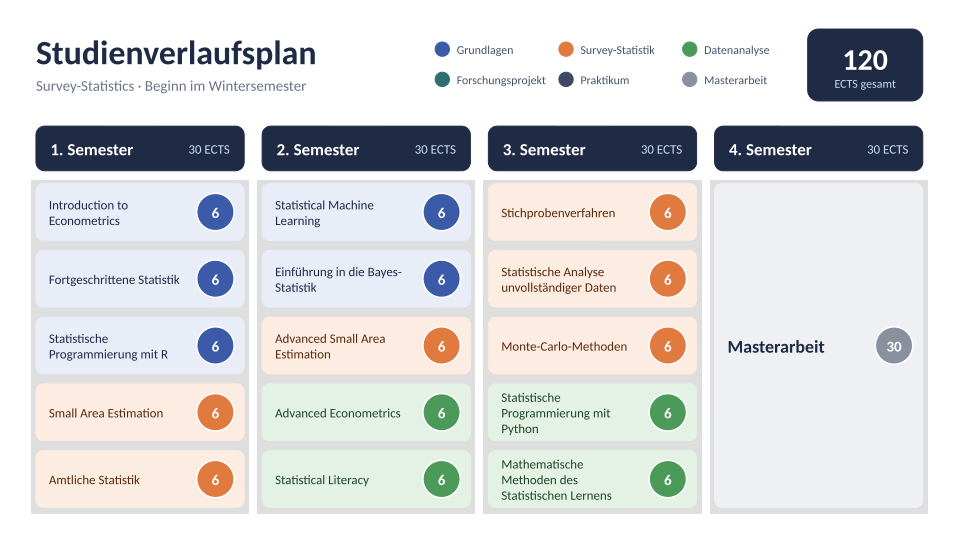
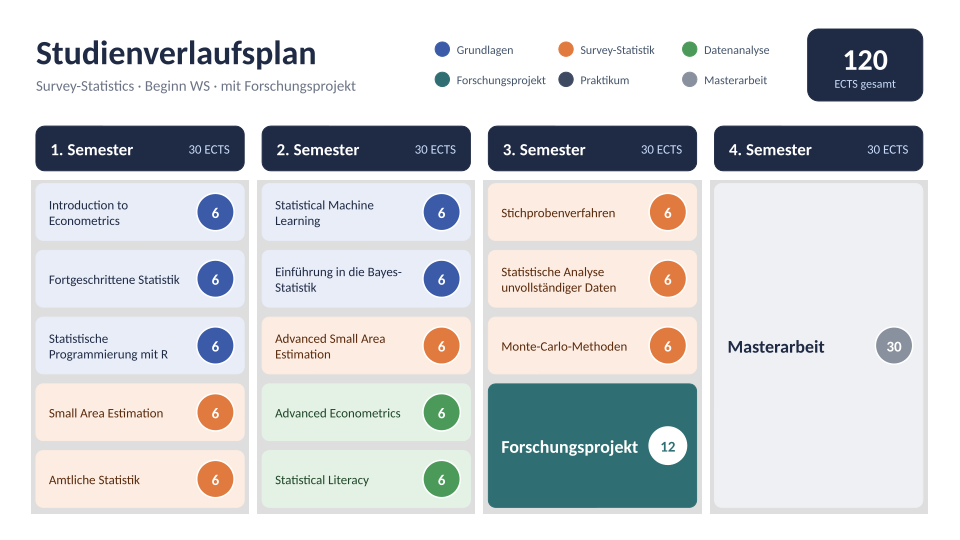
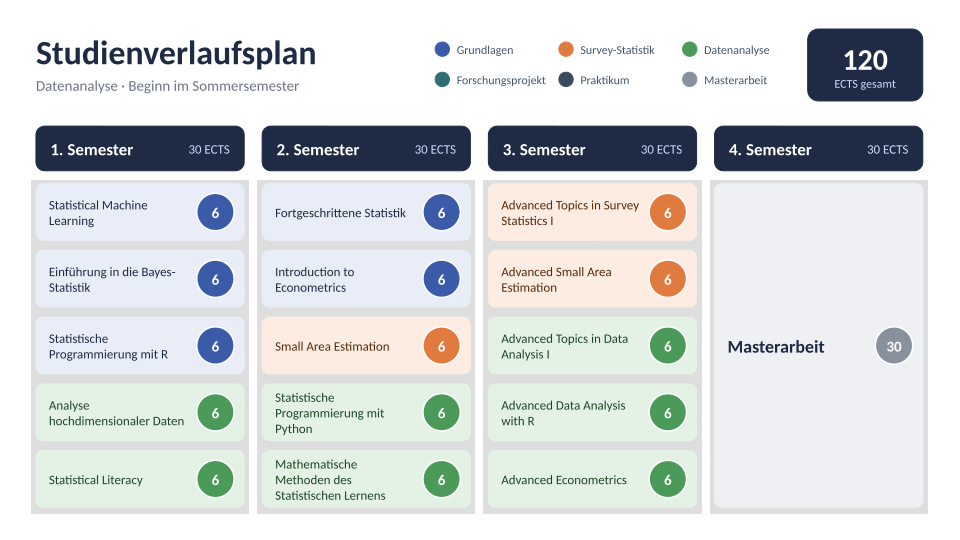
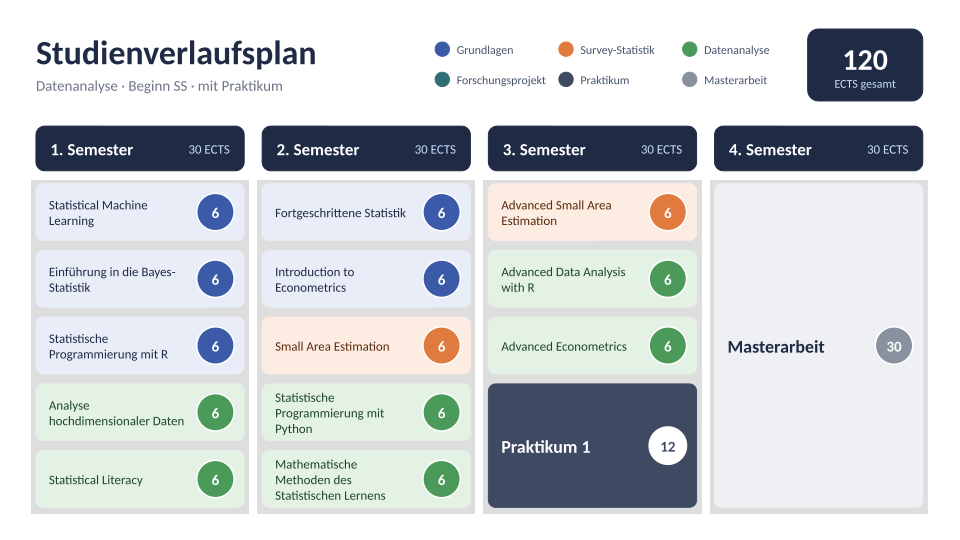
The tabs show sample study plans for the specialisations Survey Statistics, Data Analysis and EMOS Certificate. The numbers next to the module names in the study plans correspond to the number of ECTS credits awarded for the respective module. Study plans without an internship or research project achieve the required 120 ECTS credits through the module group "Application" or by taking additional modules in the module groups Data Analysis or Survey Statistics.
- WS - Specialization: Survey-Statistics
- SS - Specialization: Survey-Statistics
- WS - Specialization: Data Analysis
- SS - Specialization: Data Analysis
- EMOS-Certificate
Click on the image to enlarge
Click on the image to enlarge
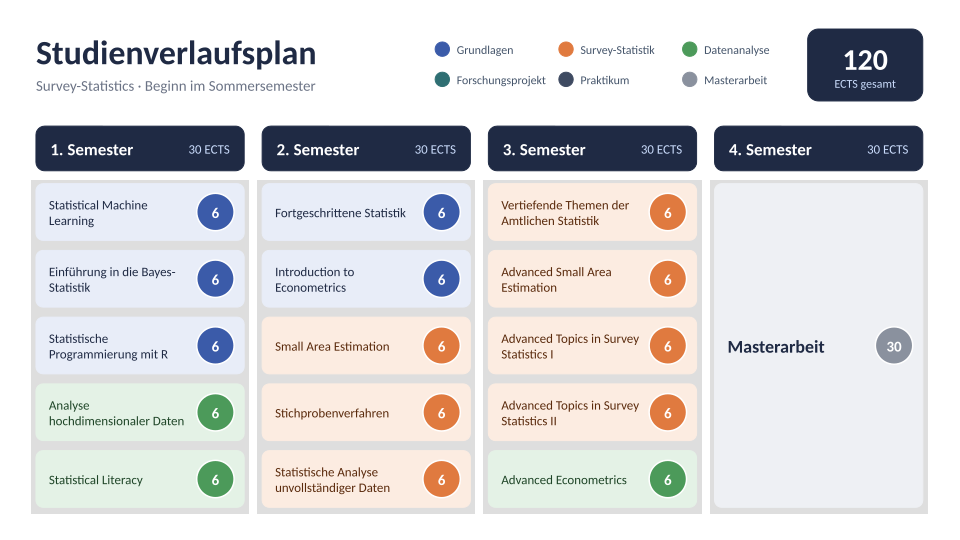
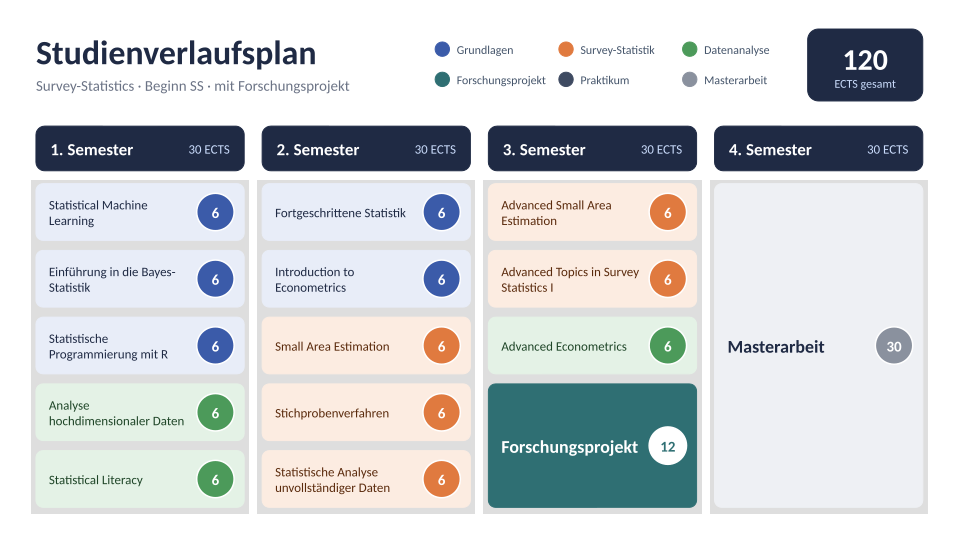
Click on the image to enlarge
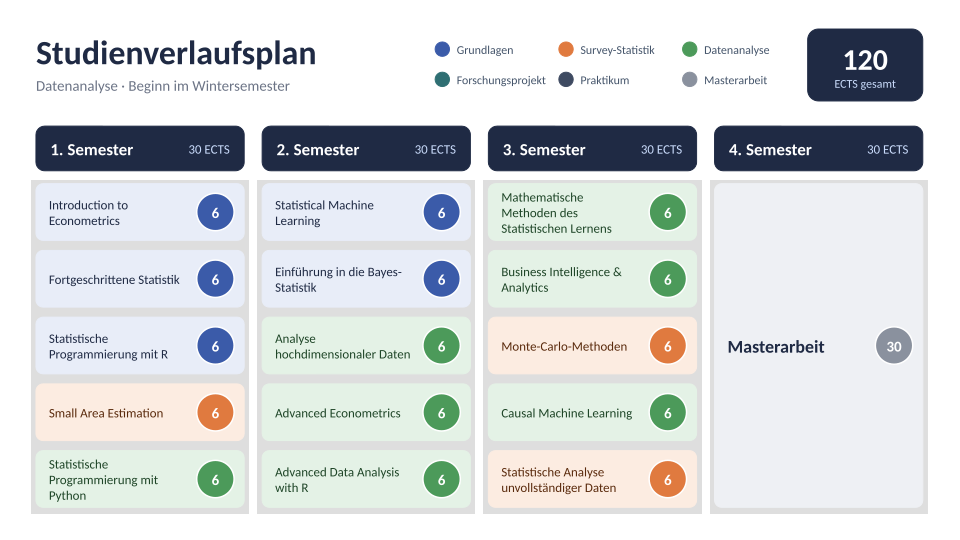
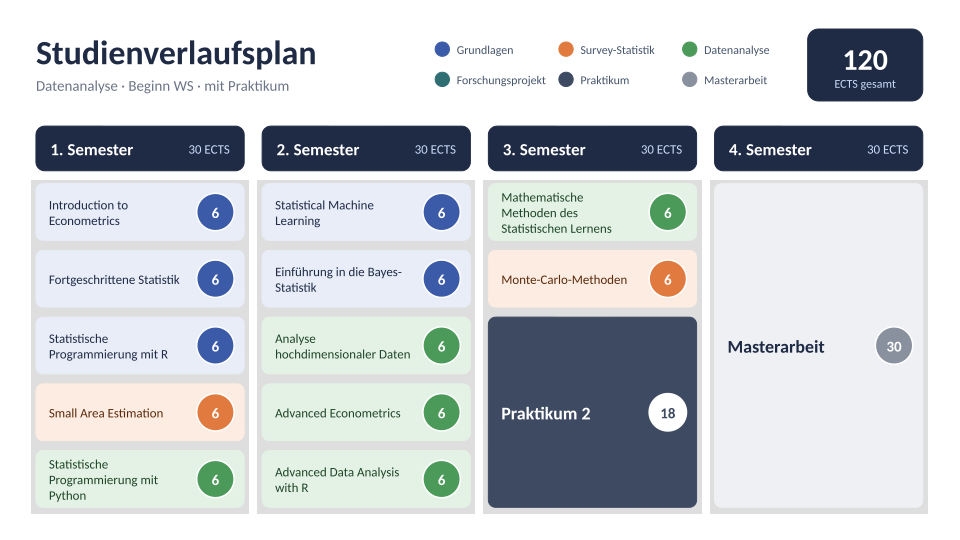
Click on the image to enlarge
Click on the image to enlarge