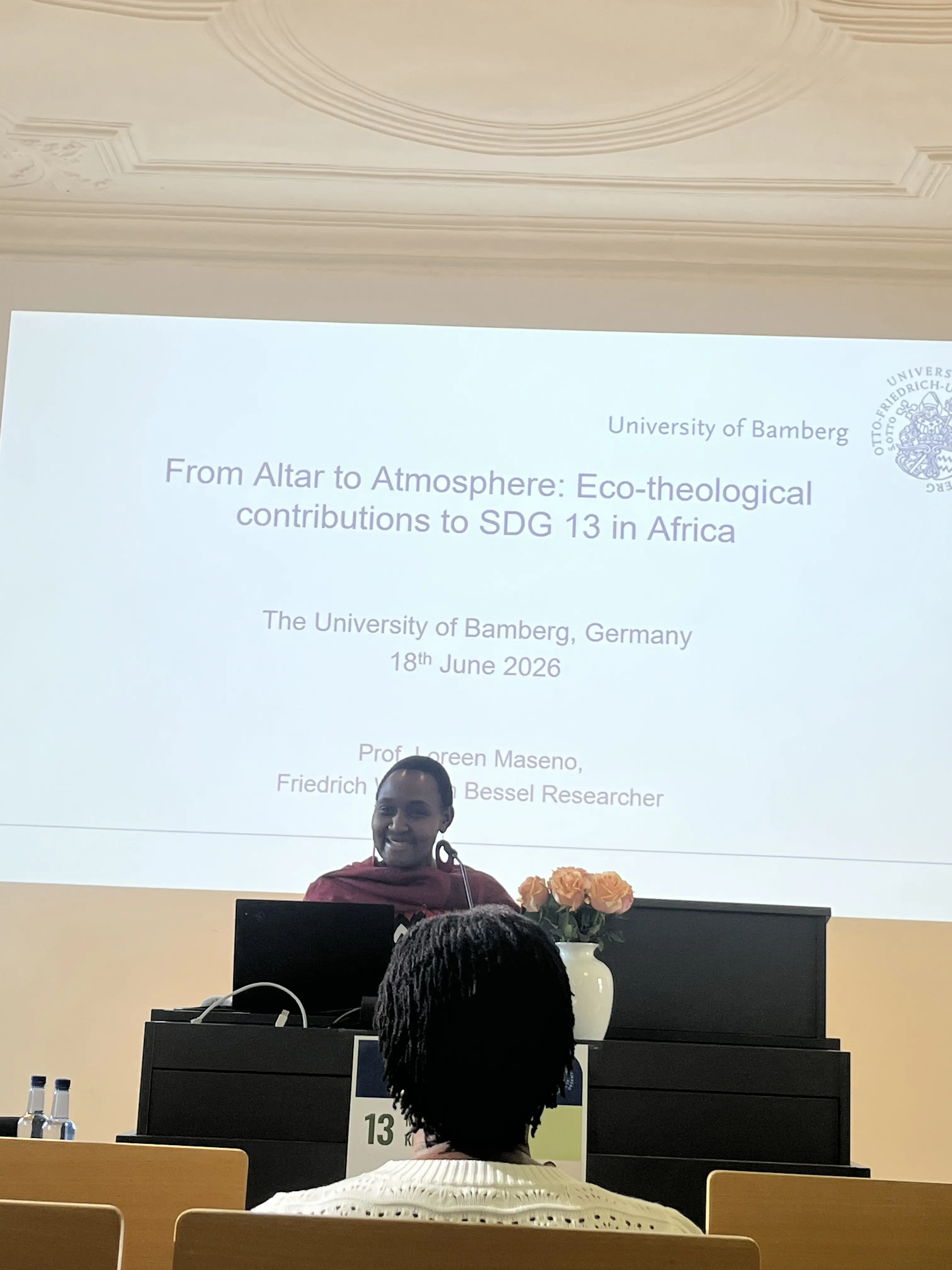
Vortrag von Prof. Dr. Loreen Maseno in Bamberg
Wie kann die Theologie einen Beitrag zu dem UN-Nachhaltigkeitsziel „Maßnahmen zum Klimaschutz“ (SDG 13) leisten? Prof. Dr. Loreen Maseno betonte in ihrem Vortrag „From Altar to Atmosphere“(433.2 KB), dass Öko-Theologie immer kontextuell sein muss, um relevant und praktisch anwendbar zu sein.
Sowohl der Auftrag zur Bewahrung der Schöpfung als auch das SDG 13 können als “calls” (Berufung) verstanden werden, die den Menschen in die Pflicht nehmen, konkret zu handeln. Insofern eignet auch dem Konzept “Nachhaltigkeit” eine religiöse Dimension.
Obwohl der Klimawandel eine globale, existenzielle Krise darstellt, sind seine Auswirkungen regional unterschiedlich. Besonders betroffen sind die trockenen und halbtrockenen Regionen Afrikas, da dort über 70 Prozent der Menschen ihre Lebensgrundlage direkt aus der Landwirtschaft beziehen.
Ebenso unterscheidet sich der Fokus der Öko-Theologie je nach Region grundlegend. Während sich die Öko-Theologie im Westen vor allem mit den Folgen des modernen Individualismus und der Konsumorientierung auseinandersetzt, verbindet sie im Süden die Quellen der Öko-Theologie direkt mit dem Kampf für Klimagerechtigkeit und wird so zu einer Ressource für praktisches Handeln.
English version
Prof. Dr. Loreen Maseno gave a lecture on 'From Altar to Atmosphere: Eco-Theological contributions to SDG 13 in Africa' at the University of Bamberg on June 18, 2026.
How can theology contribute to the UN Sustainable Development Goal "Climate Action" (SDG 13)? In her lecture "From Altar to Atmosphere," Prof. Dr. Loreen Maseno emphasized that eco-theology must always be contextual in order to be relevant and practically applicable.
Both the mandate to preserve creation and SDG 13 can be understood as "calls" that place a duty on humanity to take concrete action. In this respect, the concept of "sustainability" also possesses a religious dimension.
Although climate change represents a global, existential crisis, its impacts vary regionally. The arid and semi-arid regions of Africa are particularly affected, as over 70 percent of the population there derive their livelihoods directly from agriculture.
Similarly, the focus of eco-theology differs fundamentally depending on the region. While eco-theology in the West primarily deals with the consequences of modern individualism and consumerism, in the Global South it directly connects the sources of eco-theology with the fight for climate justice, thereby becoming a resource for practical action.