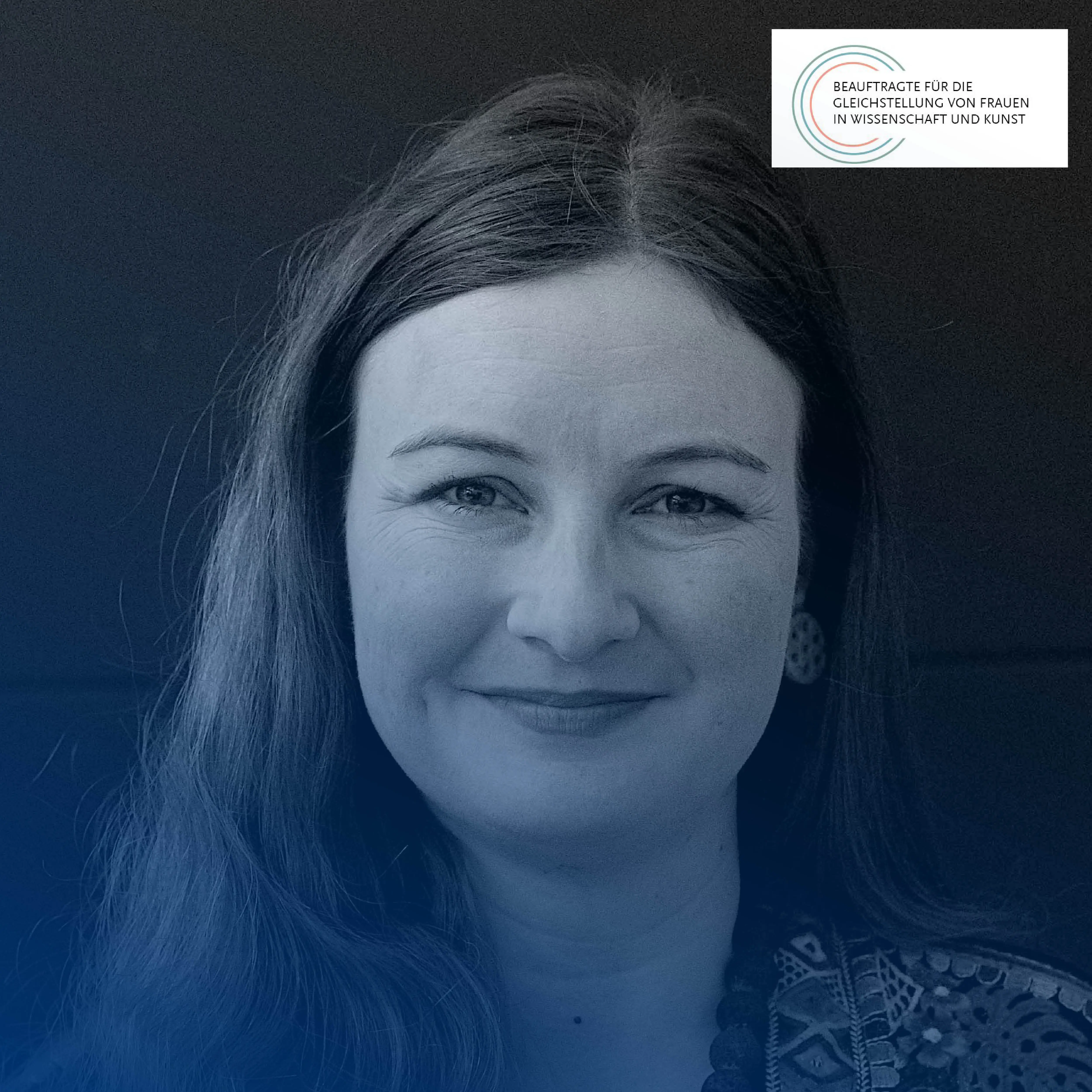
Postdoc- How do I get a research project going, Ana Grbanovic?
Interview: Sophia Wagner
Can you briefly introduce yourself and tell us what you are currently doing at the University of Bamberg?
My name is Ana Marija Grbanovic, and I’m currently employed as a Postdoc Research Associate at the University of Bamberg’s Center for Heritage Conservation Studies and Technologies (KDWT). I am currently working on my own German Research Foundation-funded research project (obtained under the “Individual Grants” funding program, known in German as the “Sachbeihilfe”). In this project, I’m studying a corpus of medieval wall paintings in Iran from an interdisciplinary perspective. The project is scheduled to last three years.
In 2022, you completed your dissertation on stucco decoration in Iran. What career options did you see for yourself at that time? Was it clear to you that you wanted to stay in academia?
I earned my PhD in Islamic Art and Archaeology at the University of Bamberg, but I had previously studied preservation of artistic and architectural heritage. After completing my dissertation, I decided to return to my previous academic field to conduct interdisciplinary research using my newly acquired knowledge.
It was clear to me that I wanted to remain in academia after completion of my doctorate. Academia offers a wide range of opportunities, and I feel at home there. After my doctorate, I was initially a Postdoctoral fellow through the University of Bamberg’s Equal Opportunities Office’s “Step by Step” fellowship programme. This transitional phase allowed me to prepare the third-party funding research proposal and get started on the project. I would like to express my sincere gratitude for this opportunity, as I would otherwise have had to leave the University.
In your experience, how difficult is it to obtain a Postdoc position? What challenges are there?
At the university level, the higher the qualification level, the more difficult it gets. In my case, there is the added factor that both Art History and Heritage Studies are relatively small academic fields. Consequently, there are only a few tenured positions at universities.
Another challenge involves balancing an academic career with private life. In many fields, a high degree of international mobility is expected. I myself earned my bachelor’s degree in Italy, my master’s in London, and my doctorate in Bamberg, and I’ve spent time in the Near and Middle East and the Caucasus on research stays, fieldwork and language courses. It’s a challenge to find a balance between international mobility and one’s private life; one frequently needs to make compromises here.
You secured your own Postdoc position by applying for a German Research Foundation Individual Grant. Why did you decide to do that?
The Postdoc phase is intended to help one become academically independent through their own research activities. Having my own German Research Foundation-funded project and Postdoc research position offers me exactly this opportunity: I can pursue my own research ideas and carry out projects independently. Personally, I enjoy writing grant proposals and conducting research projects. It gives me the freedom to decide for myself which topics I consider important and want to explore, and which areas to focus on.
I consider third-party funding proposals to be a particularly fair process in academia: they are evaluated based on academic excellence, regardless of background or other personal factors, and can be proposed in German or English. This ensures that the focus is solely on the quality of the work.
Can you describe the process of preparing such a third-party funding grant proposal? Where did you find support, and what information was helpful for you?
A successful proposal requires careful and long-term preparation, for example, to familiarise oneself with the funding body’s requirements and the proposal format. The University of Bamberg offers helpful advisory and support services for this purpose, particularly through the Division for Research Funding and Transfer (Dezernat Z/FFT) and the graduate centre Trimberg Research Academy (TRAc), which provided me with significant support throughout the process.
In addition, I am indebted to numerous academic and administrative staff members of our University, especially the KDWT Management and my colleagues at the KDWT, as well as my former supervisors and mentors.
Ultimately, third-party funding acquisition is an ongoing process in which one builds up knowledge, experience, and contacts over the course of many years. Academic exchange is very important, and I often find valuable support through my national and international network: this can take the form of conferences or discussions with experienced colleagues, during which one receives helpful advice or discusses questions together.
What does your typical workday look like in your research project?
A research project involves many different tasks. In addition to the actual research, it also comprises administrative and organisational tasks, such as project management and financial planning. The scientific work includes, among other things, field research, data analysis, publications, and participating in and organising conferences. One takes on many roles at the same time, but in doing so, one may gain numerous new skills.
How do you manage your various tasks?
Academic work also has its “seasons”: there are periods with many conferences and other times that are well-suited for fieldwork travels. As a result, my tasks vary greatly.
Good personal structuring and planning are essential, and one should not overwhelm themselves with an excessive number of tasks. I try to set myself realistic goals and to also make space for personal activities. A three-year project is not a 100-meter dash - it requires a long-term perspective.
What are your plans for the time after your project?
I would like to continue researching and lecturing in the field of Cultural Heritage Preservation and Heritage Sciences even after the project ends. I enjoy working in academia, and I am convinced that I can make a significant societal contribution through this work, which is why I see myself staying in academia from a long-term perspective.
The path in academia is not always easy, but it fulfils me. In general, it would be desirable for the future that there were more tenured positions for fractional staff at universities to strengthen the research landscape. This would enable researchers to work more sustainably and more productively.
More Information about Ana Grbanovic can be found on the website of the Centre for Heritage Conservation Studies and Technologies (KDWT)