![[Translate to English:]](/fileadmin/_processed_/6/1/csm_TEFL-transparent_818f630133.png "[Translate to English:]")
Designing VR-AI learning scenarios
This project focuses on the development of interactive and immersive learning environments for English lessons using authoring tools. Authoring tools enable immersive learning environments to be designed specificially for teaching purposes without the need for programming knowledge. Therefore, the project combines virutal reality (VR), artificial intelligence (AI), and multimodal, interactive storytelling in English lessons with the aim of promoting Education for Sustainable Development (ESD), meaning-focused interaction sowie practical cooperation with schools. Through university courses and teacher training courses, pre-service teachers and current schoolteachers are given the opportunity to develop, test and critically reflect on self-created environments for English Language Education, as well as to guide learners in the creation of immersive learning environments.
Team
- Rebecca Flämig
- Claudia Schnellbögl
- Theresa Summer
- Michelle Zirkel
Cooperations & Tools
- Cooperations: DigiZ, Stiftung Bildungspakt Bayern (projects: KI@school, proof)
- Tools: AR2VR, DelightexEdu, 3Spin
Events
University courses
- VR- and AI-assisted language learning (summer term 2026)
- Literature & immersive technologies in ELT (summer term 2026)
- Virtual Reality & ELT: Engage Your Learners! (summer term 2024 to winter term 2025/26)
Teacher training courses
- Fachtagung Englisch, 03.–04.03.2026 in Würzburg
- Virtual Reality & ESD in ELT (2024–2026)
Insights
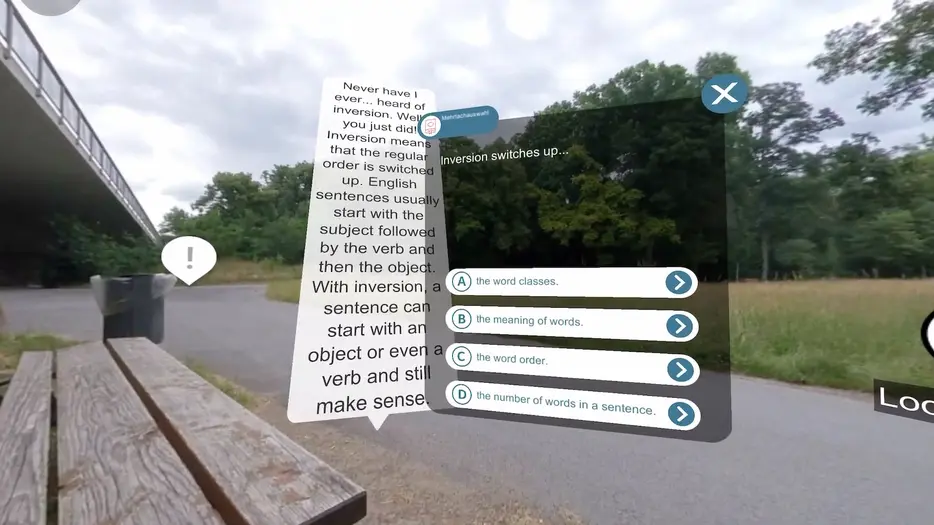
This VR environment was created using the AR2VR app with 360° photos taken by two students as part of the seminar Virtual Reality & ELT: Engage Your Learners! (summer term 2025). In this learning environment, learners immerse themselves in natural worlds and interactively develop literary skills through poems from The Lost Words by Robert Macfarlane (2017).
In addition to a tour of the VR environment on YouTube, it is also possible to explore the VR environment directly in your browser!
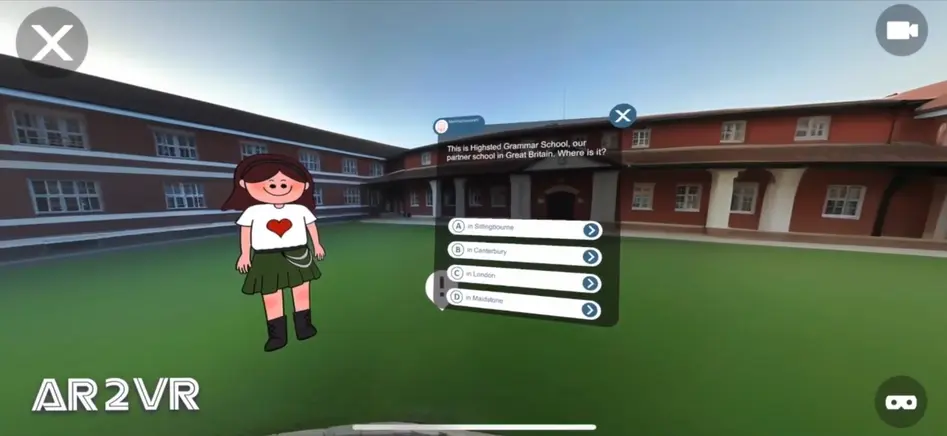
This VR environment was created by a high school teacher using the AR2VR app with AI-generated 360° images as part of the teacher training course Virtual Reality & ESD in ELT. Students accompany Frici on a virtual tour of Highstead Grammar School and, among other things, learn about several school clubs, such as the Aquarium Club and the Unicorn Club.
A tour of the VR environment is available on YouTube!
Publications
- Summer, T., Schnellbögl, C., & Zirkel, M. (2026). Pedagogical design cases of high-immersion VR in language education for sustainable development. In T. Summer, K.-H. Gerholz, & R. Kaplan-Rakowski (Eds.), Digital and AI Competence in Subject-Specific Education: International Contexts (pp.256–270). Routledge.
- Summer, T. & Flämig, R. (2025). Combining Picturebooks with Virtual Reality in the Context of Global Citizenship Education. Children's Literature in English Language Education (CLELE), 13(2), 27–50. https://clelejournal.org/article-2-2/