Intuitive Instruction
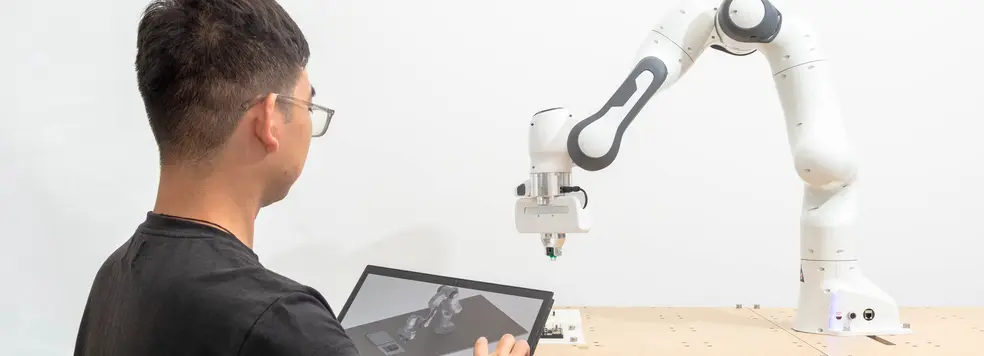
Clear Task Descriptions and Flexible Adaptation
People describe tasks to robots, demonstrate procedures, and provide feedback on execution. The systems need to interpret this input in the context of the task and use it to guide their actions. What information is required, and how can people tell whether the system has correctly understood their intentions? The methods are evaluated in terms of their technical implementation, the clarity of the interaction, and the effort required to describe and adapt tasks.
Goals and initial conditions can change after the first instruction. People therefore need ways to add to or correct their input. We also examine which parts of a description or demonstration remain useful in other situations.
Selected Research Projects
IRISS: Intuitive Roboterprogrammierung und Integration standardisierter Steuerungsschnittstellen
StMWi · 2021–2023
User interfaces, reusable and hardware-independent robot functions, and task parameterization through demonstrations.
EmPReSs: Empowerment in der Produktion von morgen – Mixed Skill Factories und kollaborative Robotersysteme neu denken
bidt · 2020–2022
Design and comparison of intuitive approaches to operation and interaction in factories that flexibly combine human and robotic capabilities.
Data Backbone: Erforschung eines Data Backbone Ansatzes für den Einsatz montagefähiger Robotiksysteme in cyberphysischen Systemen
StMWi · 2018–2020
Integrated task and process models linking production orders to robot execution, along with program synthesis for processes with many variants.
SMErobotics: The European Robotics Initiative for Strengthening the Competitiveness of SMEs in Manufacturing by Integrating Aspects of Cognitive Systems
EU FP7 · 2012–2016
Intuitive commissioning of industrial robotic systems for small and medium-sized enterprises, combining multimodal interaction with product and process models.