

Here you'll find useful information, strategies, tips, and tricks that can help you with your day-to-day life at college.
Just see what works best for you.
Have fun exploring and trying things out!
Interesting Facts
Small plants — big impact: Studies show this
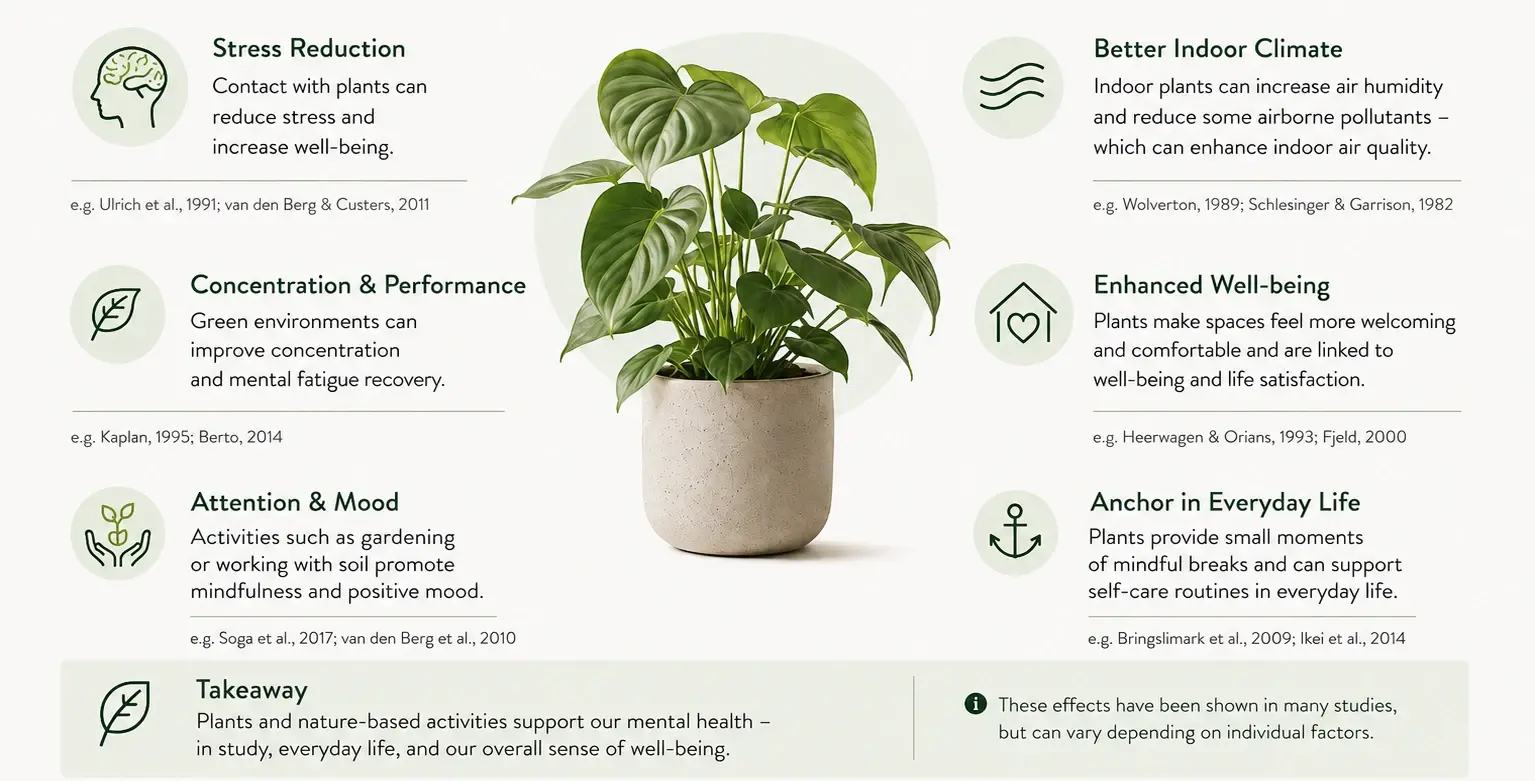
How plants can promote Well-being:
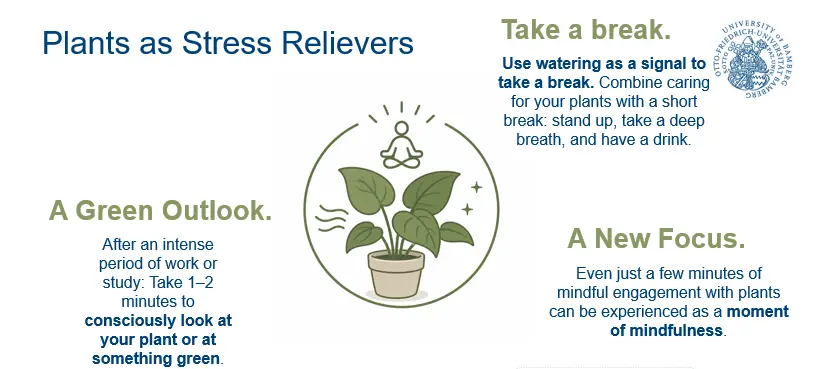

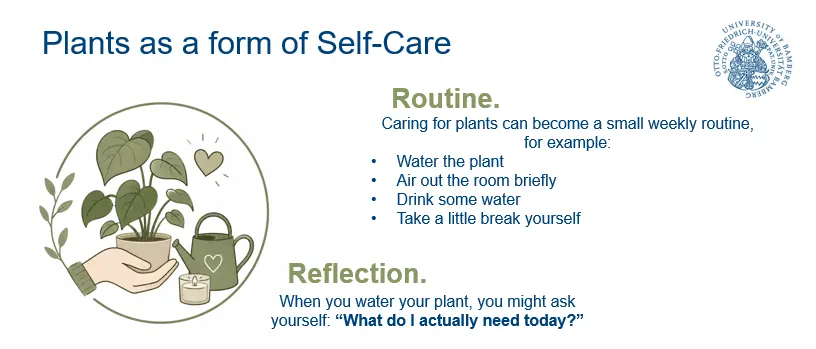
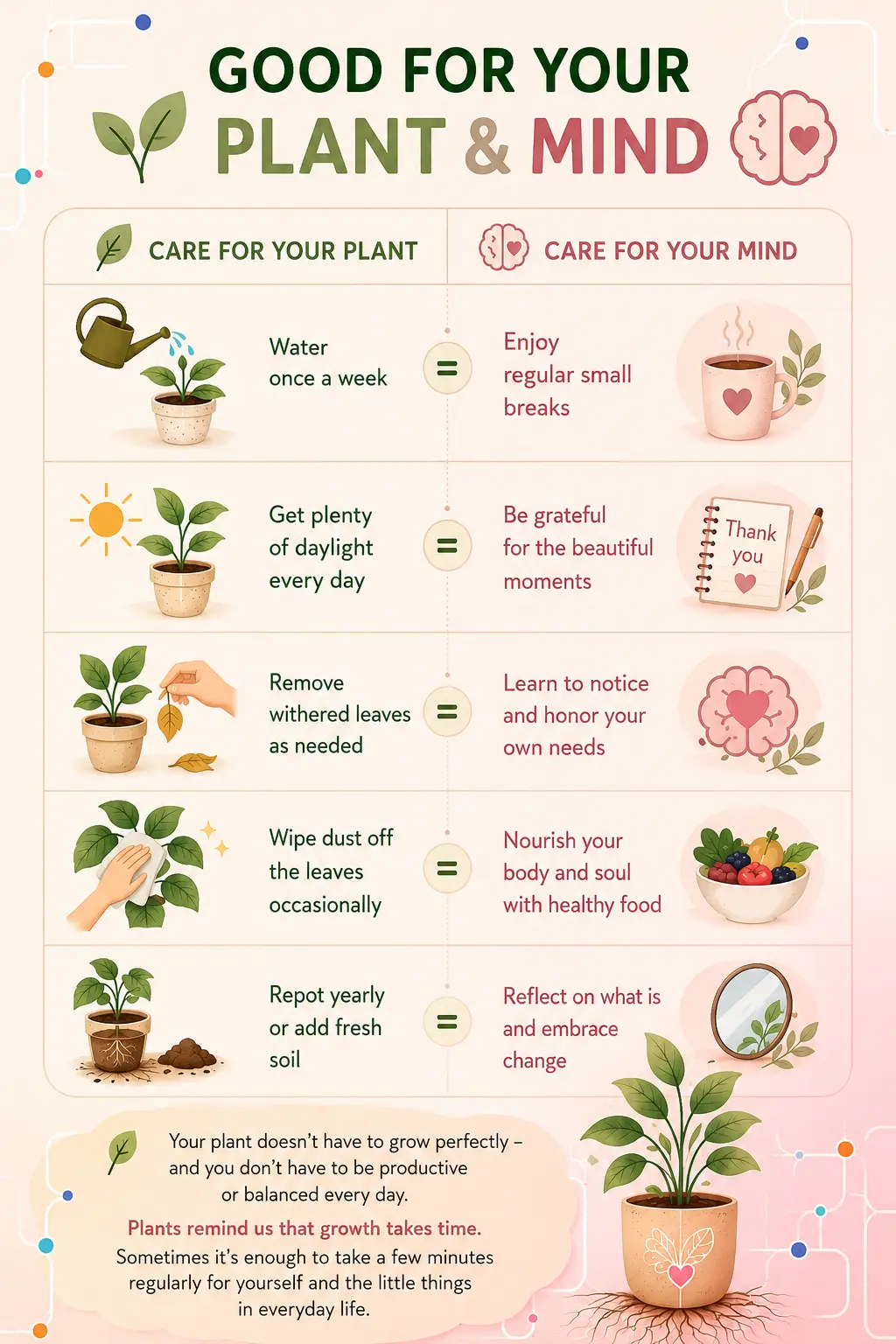



Strategies ...
... for better organization
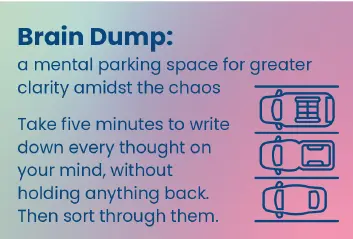
Often, lots of thoughts are whirling round in your head all at once, and you can’t really get a proper grip on any of them.
To bring some clarity to the chaos, take five minutes to write down every thought in your head. Every thought can be treated as equally important. There’s no need to filter anything out or sort it. The aim is simply to create a space for each thought.
Then take a moment to let it all sink in at a glance. You might be able to spot categories or themes. By grouping and sorting your thoughts, you’ll get a clearer picture of them all.
If you’re in the middle of a task and your thoughts keep wandering, this method can also help you feel calmer and more focused. Sort through your thoughts only after you’ve finished your previous task. Until then, they can wait in your ‘mental car park’ and won’t get lost.
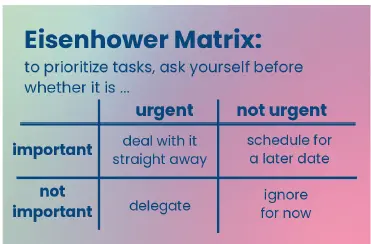
Sometimes it’s hard to work out which task you should actually start with. To prioritise tasks effectively, they can be assessed along two dimensions: urgency and importance.
So ask yourself the following questions for each task:
- How urgent is this task? (Time aspect: Is there a deadline? Do other tasks depend on it? …)
How important is this task? (Relevance: What would happen if this task were not completed?)
The tasks can now be categorised within the Eisenhower Matrix:
- Urgent and important: These tasks have the highest priority. Complete them immediately.
- Urgent but not important: These tasks are time-sensitive but do not have a high priority? Find someone in your social circle who can support you with this and take on this task.
- Important but not urgent: These tasks are not pressing, but should not be forgotten. Schedule them firmly for a later date.
- Neither important nor urgent: These tasks can be ignored for the time being or even cancelled altogether.
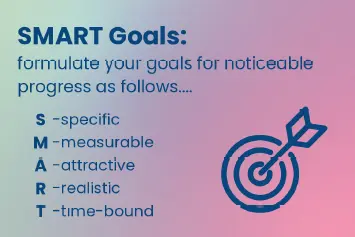
Small successes often go unnoticed, and sometimes it feels as though none of your goals have been achieved. To ensure you can really recognise your progress and celebrate it accordingly, set your goals using the SMART criteria. Here’s how:
S – Specific: Goals should be clear and concrete. What needs to happen for the goal to be achieved?
M – Measurable: To ensure the best possible monitoring, goals should be measurable using clear indicators. How will you know that you’ve got closer to your goal?
A – Attractive: A goal should be attractive to provide motivation and help you persevere. Why is it a goal? And what’s the point of it? What is the personal benefit for you?
R – Realistic: Whilst goals can be challenging, they should still be achievable. Is the goal feasible given your skills and resources? What conditions are required?
T – Time-bound: Fixed deadlines help ensure goals don’t fizzle out. By when should the goal be achieved? What milestones will help you get there? And when will you take stock of your progress?
Once you’ve answered all these questions, break the goal down into 1–2 concise sentences and write it down.
Example: “I want to do more sport” becomes “To improve my stamina, I will regularly attend university sports classes in dance and ball sports twice a week over the next semester.”

“Next term, I’ll start revising whilst the lectures are still going on.”
To successfully establish new habits like this, it’s a good idea to build on existing habits. These are already firmly integrated into your daily routine and happen almost automatically. New habits can be linked to existing routines using ‘if-then’ rules.
Rule: “If I do this, then I’ll also do that.”
Examples: “When I get home from my lecture, I’ll do some exercise.”
“Once I’ve brushed my teeth, I’ll spend five minutes revising my flashcards.”
This establishes a fixed cue, making it easier to remember the new habit, which also already has a specific time and place in your daily routine.
... for more effective learning
The to-do list is long, you know exactly what needs to be done, and yet you just can’t seem to get started? Most of the time, the first step is the hardest. To make it easier to get started despite procrastination, commit to working on the task for exactly five minutes. After that, you’re officially allowed to stop.
Set a five-minute timer and just get started. It doesn’t have to be perfect from the start. The main thing is to get started. After the timer goes off, ask yourself: Do you really want to stop now, or is the task maybe not as unpleasant as you first thought?
In most cases, once you’ve cleared that first hurdle, you’ll naturally keep working. Let the momentum carry you along.
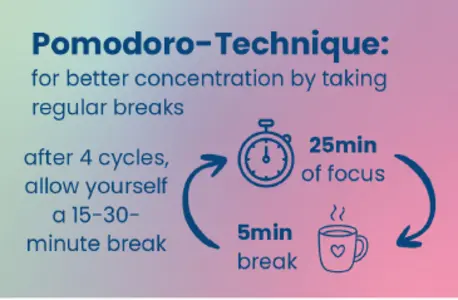
Time management methods are ideal for sustaining stamina and improving focus. The Pomodoro Technique divides work periods into intervals and incorporates regular breaks.
To do this, set a timer for 25 minutes. Work on your tasks with full focus for that duration. When the timer goes off, take a five-minute break. Then start another 25-minute work interval. This is followed by another short break.
After four 25-minute units—with three 5-minute breaks in between—allow yourself a longer break of 15 to 30 minutes. You can then repeat the cycle as often as you like.
By taking regular breaks, you prevent mental exhaustion and thereby also reduce procrastination. In addition, the breaks can serve as a reward system. It won’t be long until the next break—you can still make it!
... for Mindfulness & Relaxation
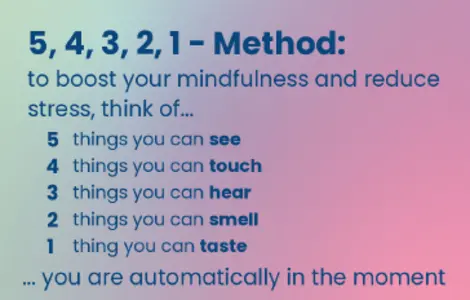
In a stressful moment, it can be calming to focus on the here and now. Mindfulness directs your awareness to the present moment, giving you a brief respite from your racing thoughts. Take a moment and think about...
5 things you can see: Let your gaze wander and explore your surroundings, or focus on small details. What can you see?
4 things you can feel: For example, feel your clothes against your body or the floor beneath your feet.
3 things you can hear: What do you hear? Is it loud or quiet? Close by or far away?
2 things you can smell: Maybe your roommate just cooked something. Or the person next to you in the library is wearing a pleasant perfume.
1 thing you can taste: What do you taste right now? And how does it taste?
Let your impressions sink in for a moment, and then return to what you were doing.
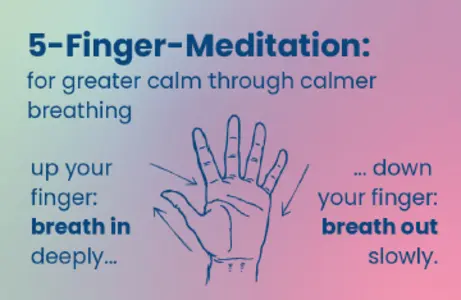
Sometimes you need a physical object to serve as an anchor to help you find calm amid the chaos of everyday life. Whether you’re on the bus, in an exam room, or at home in bed—luckily, you always have your hand with you!
To calm and deepen your breathing, open your hand and spread your fingers. Let yourself be guided, finger by finger. A gentle touch with your other hand can make the exercise easier and provide an additional relaxing sensation.
Use your right index finger to trace the side of your left thumb upward toward the fingertip. Breathe in as you do this. Once you reach the top, as you exhale, slowly trace your way back down the other side toward your left index finger. You can also gently trace this finger upward to the tip. Breathe in again, this time a little longer and deeper than before. As you trace your way back down the index finger, exhale deeply once more—a little slower than before. Repeat. Finger up—inhale; finger down—exhale. Let your breath become calmer and deeper, and your touch slower.
After moving through all your fingers, you can either end the exercise or continue. Maybe you’d like to switch hands?
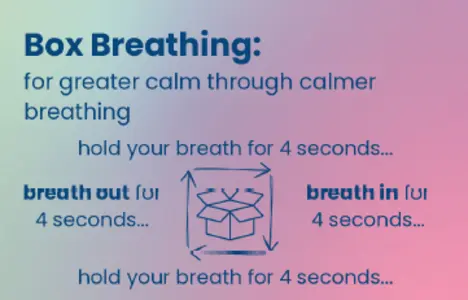
Box breathing is a great way to calm your breathing and slow things down a bit.
To do this, imagine a box or a square. If you like, you can also trace it in the air with your finger.
Breathe in, slowly count to four in your head, and move along the first side of your box. Now hold your breath for another four seconds. This corresponds to another side of your imaginary square. As you exhale, count to four again and move along another side of the box. Hold your breath for another four seconds. This completes the final leg of the journey. You should now be back at your starting point. With your breath, you’ve walked the entire perimeter of the square and are ready to inhale again.
Repeat the exercise as often as you like. This can help you slowly regulate your breathing. And maybe you’ll try it with five seconds? Or seven?
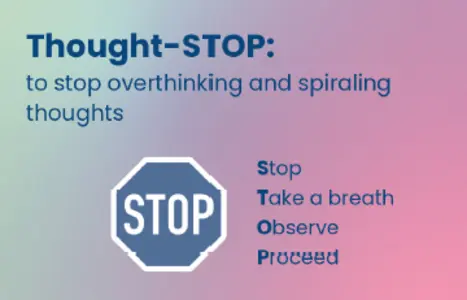
Are you constantly brooding, with your thoughts going round and round in circles, and you’d love to shout “Stop!” out loud? You can do that. But how does it work?
S – Stop: Literally think “Stop” and pause. You might also want to say it out loud or even shout it.
T – Take a Breath: Use this brief mental pause to take a deep breath.
O – Observe: Observe and take in what’s happening. What’s the actual situation? What’s this all about? Why are so many thoughts swirling around? What are your thoughts telling you? And more importantly: Is any of this true?
P – Proceed: After you’ve analyzed the situation with a little more distance, think about the smallest possible next step. Act consciously and don’t let your worries throw you off track. You can trust yourself—you’ve already mastered many situations!
At first, you might have to try it more often or practice it more frequently. That’s completely normal! With a little practice, though, your “STOP” mental technique will soon kick in immediately every time.