Bachelor of Arts in German Language, Literatures and Cultures

Start of study
Winter and summer semester
Regular study period
6 semesters, 180 ECTS credits
Interdisciplinary
Can be combined with other subjects
Degree
Bachelor of Arts (B.A.)


What makes us special
Here in Bamberg, we’re about more than just ‘good’ literature, ‘correct’ language, old books and new spelling rules!
- Following in-depth introductory courses in the core modules, we offer a wide-ranging and varied programme of compulsory-elective modules, with courses covering both ‘classic’ topics such as the ‘Nibelungenlied’, ‘Bürgerliches Trauerspiel’ or ‘syntax’, as well as on more unusual subjects such as the beginning and end of the world in the oldest German literature, letters from patients in 19th-century psychiatric hospitals, or the narrative treatment of care work in contemporary literature.
- In addition to the breadth of literary history, there is a particular focus on the contemporary literary scene and current literature: each summer semester, an author takes on the Poetics Professorship at the University of Bamberg; every semester, we invite authors to present their new texts and books as part of our reading series “Literature at the University”; in our teaching and research, we also focus on the production, distribution, teaching, and reception of literature (‘Text und Vermittlung’)
- We offer practice-oriented and career-focused modules in the field of study ‘Text und Vermittlung’ – for example, on publishing and theatre work, literary criticism and creative writing. Many of these courses are led by experts from the relevant professions.
- There are numerous possibilities for combining German Studies with other Bachelor’s degree programmes, ranging from other philological disciplines and education to social and economic sciences – such as sociology or business administration – and even computer science courses.
- Good opportunities for mutual recognition of German studies credits between Bachelor’s and teacher training programmes facilitate double degree programmes or a change of course.
Further information on teacher training programmes
Structure of the Bachelor's Degree
On the German Studies programme, you will engage in-depth with the German language, literature and culture – from their origins in the Middle Ages right up to the present day – across three key subject areas: Modern and Early German Literature, and German Linguistics.
Within the field of study ‘Text und Vermittlung’, which is included in the German Studies programmes worth 75 and 45 ECTS credits, you can also choose between two practice-oriented specialisations: ‘Literaturvermittlung’ (inluding, for instance, the production, distribution, reception of literature) and subject-specific didactics.
| Study structure | ECTS credits |
|---|---|
| Basic Module (Modern German Literary Studies, Medieval German Philology, Linguistics) | 24 |
| Advanced Modules I and II (Modern German Literary Studies, Medieval German Philology, Linguistics) | 36 |
| Basic Module: Text und Vermittlung | 9 |
| Specialisation Module (Modern German Literary Studies, Medieval German Philology, Linguistics) | 6 |
| 2. main subject or two minor subjects | 75 |
| General Studies | 18 |
| Bachelor's Thesis | 12 |
Good Reasons to Study with Us
Living internationality in Bamberg
In Bamberg, we strike a balance between a sound academic business studies programme and the development of comprehensive international skills, particularly as part of our integrated study abroad programme. Our graduates are able to operate in an international environment in a goal-orientated manner and successfully deal with specific challenges in multinational companies. With a large number of Erasmus students, a lively student life and visitors from all over the world, Bamberg is an excellent starting point for building your own international network.
The world heritage site is our campus
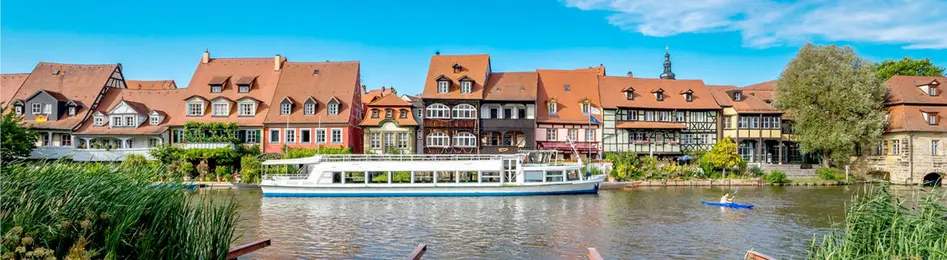
Thanks to its historic city centre, which is a UNESCO World Heritage Site, Bamberg is considered one of the most beautiful cities in Germany. With around 80,000 inhabitants and around 10,000 students, Bamberg offers an ideal setting for successful studies with flair.
The attractive location on the edge of Franconian Switzerland also offers a wide range of opportunities for sports and leisure activities to balance out the intensive academic work during your studies. The general advantages of a smaller city should also not be neglected - such as the relatively low cost of living or simply the high level of public safety.
Not least because of the advantages mentioned above, the University of Bamberg is also very popular with foreign students.
Your Qualifications
In addition to the necessary general university entrance qualification, you should also have a secure knowledge of English (and Latin if you are going to write your Bachelor's thesis in Medieval German Philology or Linguistics).
Prospective students who have a foreign nationality and a foreign university entrance qualification must apply to the International Office for a Bachelor's degree programme at the University of Bamberg. There, it is checked whether the required higher education entrance qualification and the required German language skills are available.
Master's programmes after your Bachelor
The Bachelor’s programme prepares students for a potential Master’s programme. The University of Bamberg generally offers a wide range of options in this regard; the Institute of German Studies, in particular, offers Master’s programmes in: