MAI:Ring

Participants
Prof. Dr. Patrick Tobias Fischer (Juniorprofessur für User Experience and Design)
Dr. Dorothea Breier (Referat für Wirtschaft und Digitalisierung - Programm Smart City Bamberg)
Dr. Ayman Alanssary (Studentische Hilfskraft User Experience and Design)
Kontakt: ayman.alanssary(at)uni-bamberg.de
Brief Description
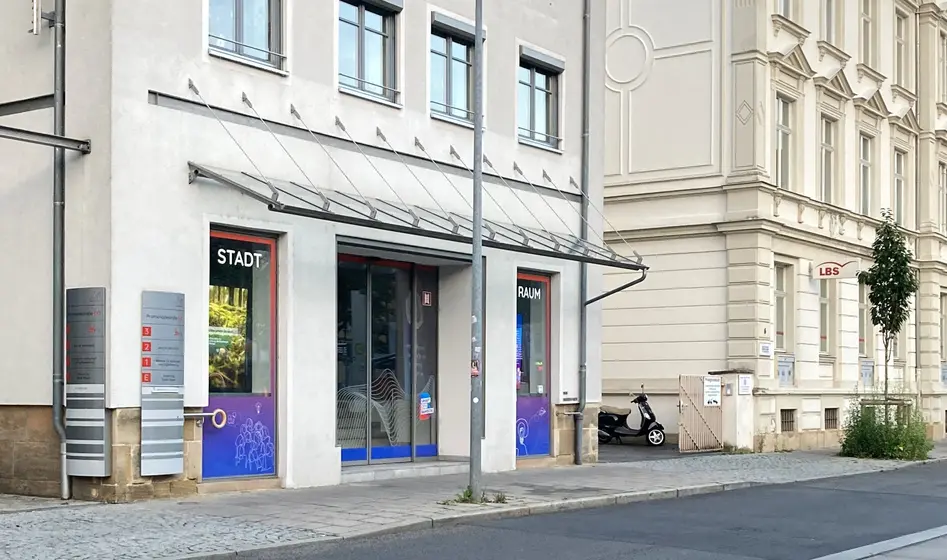
“MAI:Ring” is a media architectural project in the city centre of Bamberg that investigates how people interact with digital media in public spaces. It combines a wooden ring device with a 55-inch vertical screen, creating an interactive physical interface integrated into a building's façade. Pedestrians can use the ring to navigate and interact with content displayed on the screen. The project is envisioned to transform passive information display into an interactive experience and to offer meaningful content to the public.
MAI stands for Media Architectural Interface, highlighting our goal of integrating interactive media technology into architecture and the urban space. MAI:Ring is integrated with the building façade of the Stadt:Raum at Promenadestraße 6a, extending one of the two public displays of the Smart City Bamberg programme. The novel user interface and its basic application framework were built by Prof. Dr. Patrick Tobias Fischer and deployed, developed and maintained in cooperation with Smart City Bamberg. Currently the hardware is deployed for long-term use, and the system is running multiple applications while further content is welcomed.
The permanently installed interface is systematically collecting user interaction rates and patterns to evaluate how interactions evolve over time and uncover the potential applications of this technology. By moving beyond traditional formats like LED billboards and multitouch displays, the experimental project explores how people engage with new media formats in urban spaces.
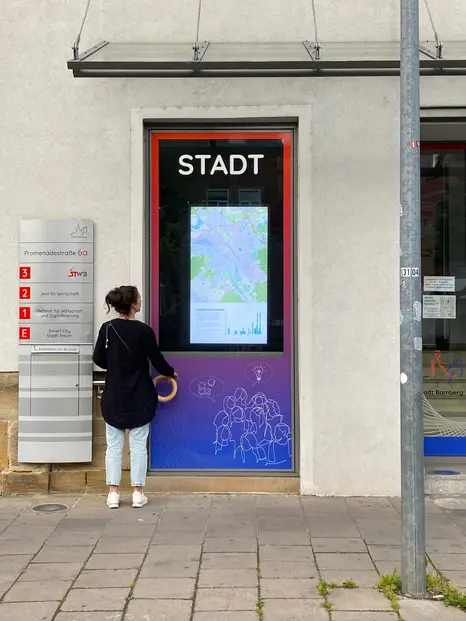
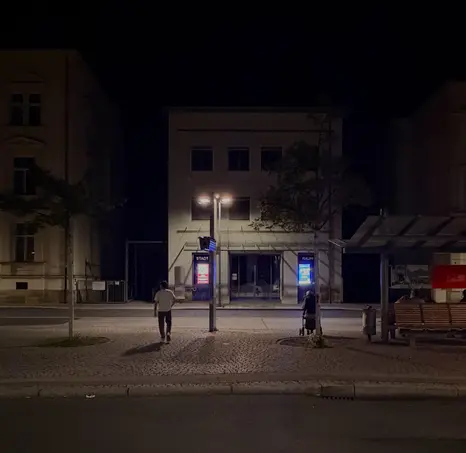
MAI:Ring is aimed to experiment primarily with three different types of content:
(1) artistic: such as animations, visualizations, short films, and interactive concepts;
(2) education and research-related: such as projects by academics and students to showcase research works or gather public input;
(3) participatory: relevant to the city, its services and development.
This offers valuable opportunities for potential content creators to present their ideas in a highly visible space for an extended period of time.
Through this project, we aim to:
(1) Analyse how interaction patterns with media interfaces in the city space are influenced by foot traffic, timing, content types, and spatial context;
(2) Explore the added value of media architectural interfaces in urban environments as tools for community engagement and social interaction;
(3) Understand the potential of new media formats and interactive styles relative to established formats for (interactive) public displays and media architecture.
If you have a proposal for content, please contact us. Our team can provide technical support and advice for developing the interactive features.
For more details and technical information, see: https://lab.uxd.uni-bamberg.de/UxD-SCL-Ring