
Mobi Team goes IEEE SMARTCOMP 2026
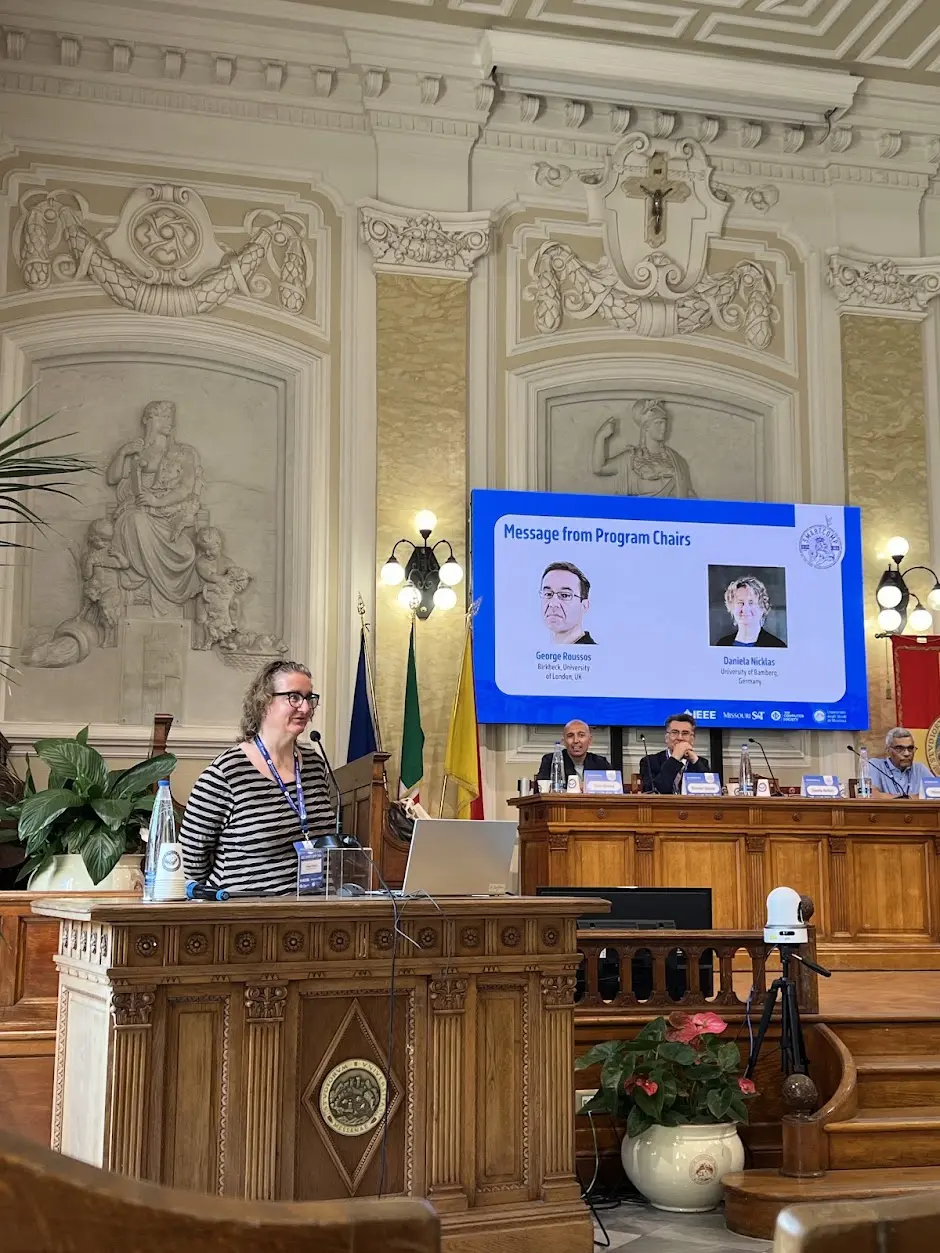
From 22nd to 25th June 2026, Prof. Dr. Daniela Nicklas, Abeera Ayesha Riaz and Leonie Ackermann attended the SMARTCOMP 2026, the premier conference on smart computing in Messina, Italy.
Prof. Dr. Nicklas has been Programme Co-Chair of the SMARTCOMP 2026 and additionally participated in a panel on "Intelligent Spaces: Smart Computing in the age of Generative and Agentic AI". Together with Prof. Dr. Antonio Puliafito, Prof. Dr. Hirozumi Yamaguchi and Prof. Dr. Carlo Vallati she presented visions for the future of smart computing.
Envisioning Tomorrow: The Future City and Urban Resilience
Prof. Dr. Nicklas "Future City" is a compelling vision of urban living that intertwines technology and resilience. In her scenario, residents inhabit city with many green spaces, with buildings and mobility services that are seamlessly integrated with digital cloud-based services. Additionally she highlights the need for urban centers to prepare for potential disruptions. This preparation includes establishing robust local energy systems and ensuring that essential services remain operational even during crises. Within this framework, technology, particularly agentic AI, is set to play a crucial in bolstering urban resilience. AI can automate and optimize city systems, monitor infrastructure, and facilitate rapid response mechanisms during emergencies.
However, the transition to such a model of urban life comes with its challenges. While the long-term benefits of these investments are substantial, the higher short-term costs may be a deterrent to immediate action. It is also important to recognize the diversity within urban populations; the heterogeneity of residents presents challenges necessitating tailored approaches to cater to varying needs.
Despite these hurdles, the "Future City" concept holds considerable promise. One of the key opportunities lies in boosting local economies. By harnessing local resources and services, cities can stimulate job creation and support local businesses, fostering an environment of economic resilience. Additionally, what has traditionally been viewed as inefficiency—redundant systems—can actually provide crucial backups, contributing to overall reliability in urban infrastructure. Although the initial investments may be significant, the potential for long-term cost reductions through enhanced efficiency and innovation presents a compelling opportunity for cities ready to embrace this transformative vision.
Addressing Data Sparsity in Smart Mobility
In the session titled "Smart Mobility and Urban Systems," Abeera Ayesha Riaz, a new PhD candidate at the Chair of Mobile Systems since April, presented the paper, "Navigating Sparsity: Evaluating the Impact of Controlled Data Reduction on Synthetic Mobility Data Utility." Co-authored by her colleagues Muhammad Tayyab Shafique, Debasree Das, and Leonie Ackermann, the paper explores the challenges of utilizing synthetic mobility data within the context of Smart Cities, particularly focusing on the New York City CitiBike system as a case study. As urban environments increasingly rely on data to improve transportation efficiency and enhance service delivery, synthetic data is often proposed as a solution to overcome limitations in sharing and accessing real-world mobility data.
When a mobility dataset is rich in information ranging from spatial to seasonal coverage with dense usage, it supports a wide range of applications, from urban transportation planning to operator strategies for alternative modes of transportation. But sparsity in data is often a real-time problem arising from partial infrastructure coverage, outages, sampling constraints, usage patterns, and operational noise. A central practical question is whether the synthetic data remains useful when the training data itself becomes sparse. Consequently, we investigate the extent to which sparsity in the training data propagates to the generated samples and affects their downstream usefulness.
Overall, this work highlights the critical need to understand and address data sparsity issues in mobility data to effectively harness the potential of synthetic datasets in improving urban transportation systems within Smart Cities.
Gratitude for an Unforgettable SMARTCOMP Experience
Attending SMARTCOMP was an incredible experience for the entire team. We were truly impressed by the inspiring atmosphere and the wealth of knowledge shared throughout the event. The opportunity to connect and network with fellow professionals and researchers was invaluable, fostering collaborations that will undoubtedly enhance our future projects. A heartfelt thank you goes out to the organizers for their meticulous planning and for creating such a welcoming environment. We left inspired and excited about the possibilities ahead!