
Disinformation, Democracy and Epistemic Breakdown
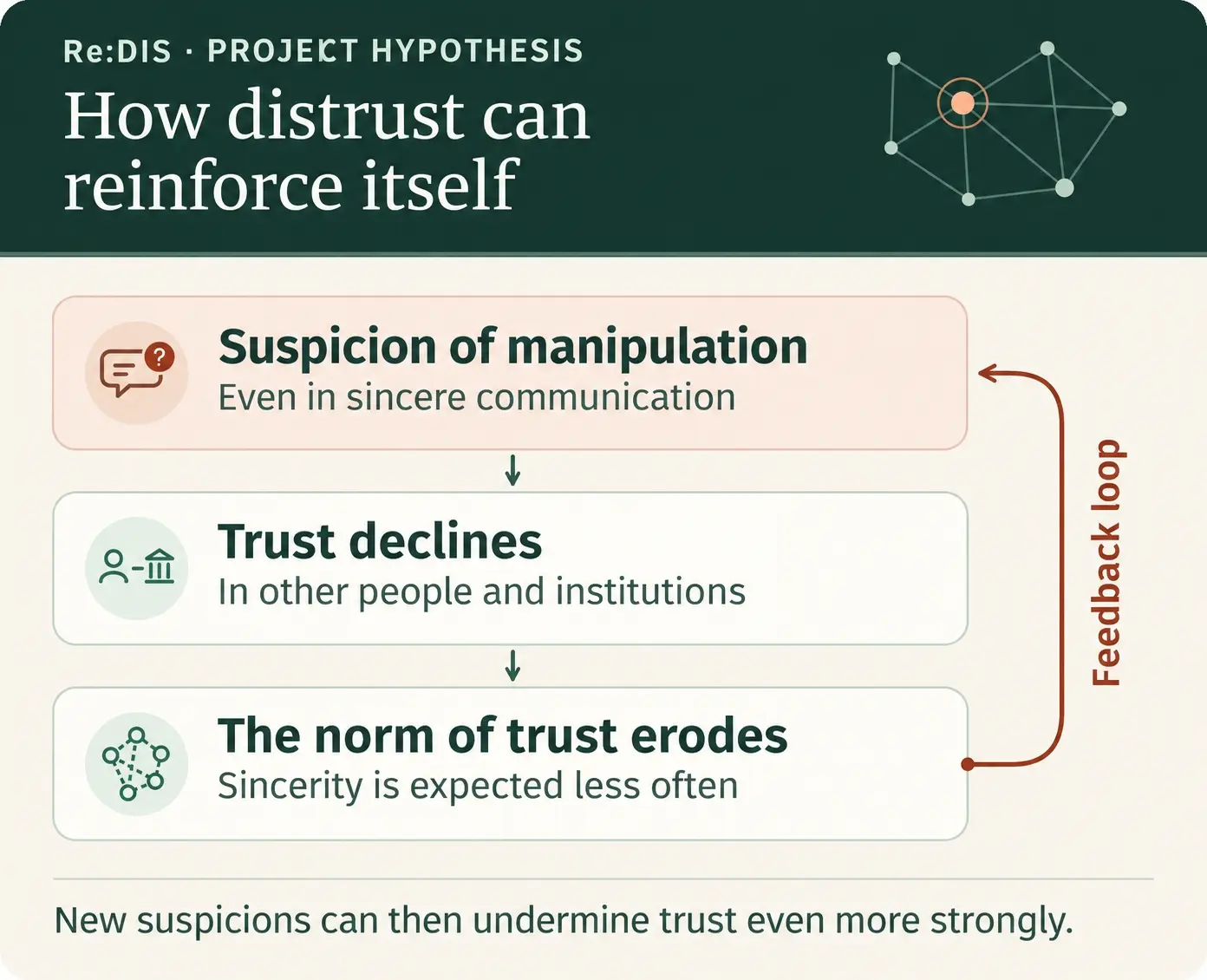
When suspicion of manipulation undermines trust
Disinformation can cause harm even when it convinces hardly anyone of a false claim. The mere suspicion of being deliberately deceived can undermine trust in a source. Even a sincere message can trigger such suspicion.
We investigate when this gives rise to a spiral of distrust that makes it increasingly difficult to rely on shared facts in political disagreement.
How distrust spreads
In agent-based computer simulations, we model how people exchange information in social networks and assess the credibility of their sources. We examine how interpersonal trust, trust in science, the media, and public institutions, and shared expectations of sincere communication interact.
In the first model, we investigate how distrust can spread through the mere suspicion of manipulation. The second model introduces actors who deliberately disseminate misleading information. A particular focus is on epistemic populism, which elevates “common sense” over the knowledge of experts and institutions and can reinforce existing distrust.
How can democracies respond?
Based on the simulations, we investigate under what conditions measures such as fact-checking or labelling misleading content can support informed public debate. Drawing on democratic theory, we assess when such measures are proportionate and compatible with freedom of expression and pluralism.
A web simulation for civic education
With the Epistemic Walkthrough, we are developing a freely accessible web simulation for schools and interested members of the public. Users can explore different communication scenarios and countermeasures and observe how trust changes within the model. The tool will be piloted at a partner secondary school in Augsburg. Accompanying teaching materials will be developed for classroom use.
Project leads
Prof. Dr. Johannes Marx and Dr. Simon Scheller, University of Bamberg
Project team
Soeun Jeon and Timucin Talay
Cooperating Partner and Mercator Fellow
Dr. Daniel Mayerhoffer, Assistant Professor Computational Social Science, University of Amsterdam
Funding
German Research Foundation (DFG), Priority Programme 2573 Rethinking Disinformation (Re:DIS)
Project start and duration
November 2026 · 36 months