Bronze Age centers in the Po Basin (Italy)
The final phase of the Bronze Age was a period of profound change in Italy and throughout the Mediterranean region. During this dynamic period, a new settlement system emerged along the major rivers of northern Italy, the Po and the Adige. These were not merely settlements, but also specialised craft centres and important trading hubs with long-distance links to the Baltic region, North Africa and the Levant. The best-known of these centres is Frattesina, near present-day Fratta Polesine, which was founded in the 13th century BC on the south bank of the Po. So far, it is the only Bronze Age site in Italy where glass production has been documented – a new industry most likely inspired by Egyptian workshops. Frattesina flourished until the River Po changed its course in the early first millennium BC.
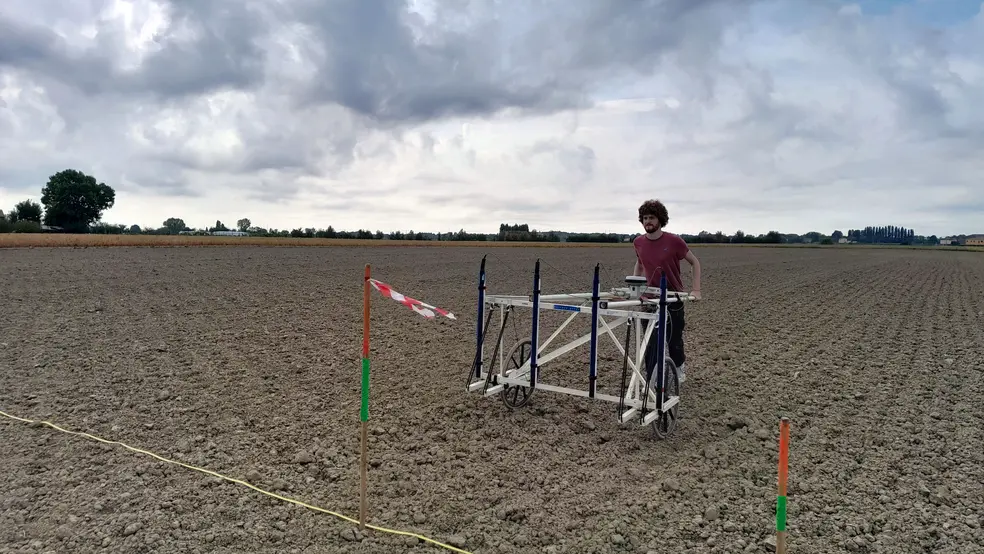
Frattesina and its neighbours offer exceptional opportunities for non-invasive surveys. These settlements are situated on flat agricultural land and have never been re-occupied. Aerial photographs have helped to determine the shape and extent of Frattesina along central, perpendicular canals and to divide the inhabited area into regularly arranged quarters. Large-scale magnetometry now offers a new perspective on the detailed layout of Frattesina and its surroundings, including the location of workshop areas, the architecture of individual buildings and the activity zones outside the dense settlement centres.
Since 2019, we have been working in Frattesina in collaboration with Sapienza University of Rome and the heritage conservation authority. We now have an almost complete map of the Bronze Age settlement and its surroundings. Further collaborations with the Universities of Padua, Verona and Milan allow us to collect more data on similar sites, through which we can refine non-invasive research approaches to prehistoric settled landscapes in the Po basin. Since 2023, we work on Frattesina's neighbours Villamarzana and Campestrin, as well as two centers in the Grandi Valli Veronesi: Lovara di Bartolomea and Terranegra.
From 2026 onwards, we will extend out work in the large center of Campo Verde (near Pavia). Together, these case studies allow us to explore the spatial organization of contemporary Bronze Age centers, to refine our survey methodologies, and to evaluate our data interpretation through geoarchaeological approaches.
Contact: dr. Wieke de Neef, wieke.de-neef(at)uni-bamberg.de