
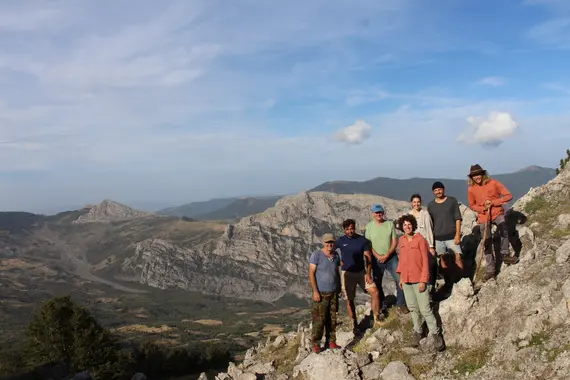
Pollino Archaeological Landscape Project
The Pollino Mountains are situated at the southern end of the Apennines in Italy, on the border between the regions of Calabria and Basilicata. Since 2020, an international team of archaeologists, environmental experts and survey specialists has been working together to situate this mountainous landscape within long-term settlement patterns in southern Italy.
The Pollino Archaeological Landscape Project (PALP) is a research collaboration between the Institutes of Archaeology at the Universities of Bamberg (Germany) and Groningen (Netherlands) and the Gruppo Speleologico ‘Sparviere’ (Italy), supported by the Pollino National Park / UNESCO Geopark in southern Italy. The project aims to map the long-term human impact on the mountainous landscape of the Pollino Mountains and to integrate the seasonal settlement of the highlands into models for permanently settled lowland areas. We combine archaeological approaches (surveys, geophysics) with ethnographic studies of recent mountain use (interviews, topographical studies of shepherds’ camps) and environmental research (core sampling for palynology, macroremains and soil studies).
Project leaders: Dr Wieke de Neef (Bamberg) and Prof. Dr Peter Attema (Groningen)
Project website: pollinoproject.com
Further information: wieke.de-neef@uni-bamberg.de