
Courses
The chair teaches deep learning and the mathematics of machine learning. The figure shows a recommended path through our courses; below it, each course opens to show what it covers, who it is for, when it runs and what it earns. The UnivIS list at the end of the page links to the current run of each course and to its exercises, with dates, rooms and lecturers.
Recommended path
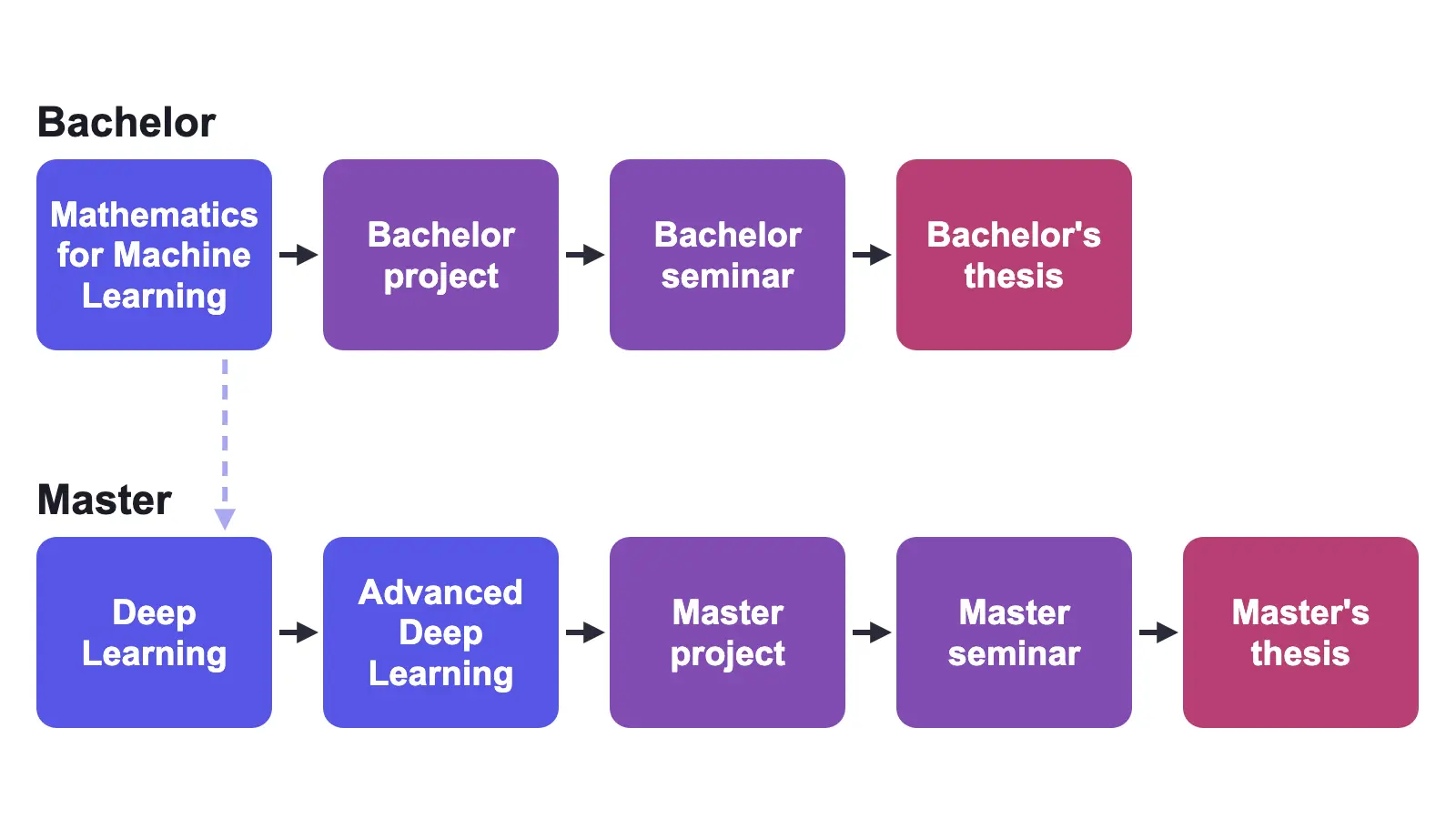
We recommend this order. In the Bachelor's program: Mathematics for Machine Learning, then the Bachelor project, the Bachelor seminar and the Bachelor's thesis. In the Master's program: Deep Learning, then Advanced Deep Learning, the Master project, the Master seminar and the Master's thesis; the Master and doctoral seminar accompanies the Master's thesis. Mathematics for Machine Learning prepares for Deep Learning. The order is not a requirement; what a thesis requires is on Theses.
Lectures at a glance
The mathematics that machine learning builds on: linear algebra and analytic geometry, matrix decompositions, vector calculus, information theory, probability and statistics, and optimization, applied to problems such as density estimation and dimensionality reduction. The exercises combine proofs with implementations in Python. The course prepares for Deep Learning.
- For: BSc Artificial Intelligence and Data Science, Applied Computer Science, Computer Science and Information Systems; MSc Computing in the Humanities; MSc Applied Computer Science, Information Systems and International Software Systems Science on request at the examination office
- Term: summer, every year
- Language: English
- Credits: 6 ECTS; lecture and exercise, 2 SWS each; written exam of 90 minutes
- Prior knowledge: none required; programming and earlier mathematics courses help
An introduction to deep learning: feedforward and convolutional networks, regularization and optimization, classification, detection and segmentation, generative models, attention and transformers, and how to evaluate a model. Assignments in Python accompany the lecture; they are optional and earn bonus points of up to 20 % of the exam points.
- For: BSc Artificial Intelligence and Data Science (KI&DS); MSc Applied Computer Science, Information Systems, Computing in the Humanities and International Software Systems Science
- Term: winter, every year
- Language: English
- Credits: 6 ECTS; lecture and exercise, 2 SWS each; written exam of 90 minutes
- Recommended: programming in Python and Mathematics for Machine Learning (xAI-MML-B)
The continuation of Deep Learning: transformers, self-supervised learning (for example CLIP and DINO), detection and segmentation (for example DETR and SAM), diffusion and flow models, privacy-preserving training with federated learning, and deep learning in medicine.
- For: BSc Artificial Intelligence and Data Science; MSc Applied Computer Science, Information Systems, Computing in the Humanities and International Software Systems Science
- Term: winter 2026/27
- Language: English
- Registration: by e-mail to the lecturer before the term, with transcripts (details in UnivIS below)
- Recommended: programming in Python, Mathematics for Machine Learning and Deep Learning
Seminars and projects at a glance
Each run of a seminar or project has its own topic, announced in its UnivIS entry and in its course on the Virtual Campus. Seminars and projects are usually offered every term; the UnivIS list below shows what runs now. What stays the same from run to run:
Each run has one focus topic from machine learning and computer vision, often with medical images; past topics were the evaluation of AI models, medical imaging, machine learning in healthcare and trustworthy AI. Participants work on one topic each, starting from literature the lecturers point them to.
- For: BSc Applied Computer Science, Artificial Intelligence and Data Science and Software Systems Science; BSc Information Systems only after consulting the examination office
- Credits: 3 ECTS; 2 SWS
- Registration: by e-mail to the lecturer with name, matriculation number and degree program
A seminar on current research in machine learning and computer vision. In winter it is held jointly with FAU Erlangen-Nürnberg on human-in-the-loop machine learning with a focus on healthcare, with students attending at their home university: each participant presents an assigned topic in a talk of 20 minutes plus 5 minutes of questions and writes a report of about 8 pages, both in English and weighted equally in the grade. Summer runs have their own focus topic, such as deep learning or out-of-distribution data.
- For: MSc Applied Computer Science, Information Systems, Computing in the Humanities and International Software Systems Science
- Credits: 3 ECTS; 2 SWS
- Recommended: a passed exam such as Deep Learning (xAI-DL-M), Mathematics for Machine Learning, Machine Learning (KogSys-ML-M) or Introduction to AI (AI-KI-B)
A hands-on project in Python: students explore a dataset, train and evaluate machine learning and deep learning models and write up what they found. Past topics were the analysis and visualization of a fine-grained bird dataset and the training and evaluation of neural networks for image classification. No prior knowledge of machine learning is required. The project is recommended preparation for Deep Learning and Advanced Deep Learning.
- For: BSc Applied Computer Science and Artificial Intelligence and Data Science; MSc International Software Systems Science only with a learning agreement
- Credits: 6 ECTS; 4 SWS
- Prior knowledge: none required; programming in Python helps
A research project in teams of three to four students on an open question of robust machine learning: the team reads the literature, implements baselines and current methods in Python, compares them and presents its results in a talk and a written report. Recent runs addressed domain generalization, where a model has to work on domains it never saw in training.
- For: MSc Applied Computer Science, Information Systems and Computing in the Humanities
- Credits: 6 ECTS; 4 SWS
- Required: a passed exam in at least one of Deep Learning (xAI-DL-M), Mathematics for Machine Learning, Machine Learning (KogSys-ML-M) or Introduction to AI (AI-KI-B)
A forum for current and future Master and doctoral thesis topics, research projects and trends in the international research community, held online with students of FAU Erlangen-Nürnberg and Imperial College London. For Master students who write or plan a Master thesis, and for everyone interested in current research.
- Scope: 2 SWS
- Registration: by e-mail to Prof. Dr. Christian Ledig
Courses this term (UnivIS)
The list below comes from UnivIS and shows the current term: lectures, exercises, seminars and projects, each with a link to its dates and rooms. Its group headings are in German.
- xAI-ADL-M: Advanced Deep Learning (xAI-ADL-M)
- SWS
- Shyam Rai
- Details in UnivISzur Lehrveranstaltung xAI-ADL-M: Advanced Deep Learning
- xAI-DL-M: Deep Learning (xAI-DL)
- 4 SWS
- Christian Ledig
- Details in UnivISzur Lehrveranstaltung xAI-DL-M: Deep Learning
- xAI-DL-M: Deep Learning, Gruppe 1
- 2,00 SWS
- Sebastian Dörrich , Jonas Alle
- Details in UnivISzur Lehrveranstaltung xAI-DL-M: Deep Learning, Gruppe 1
- xAI-DL-M: Deep Learning, Gruppe 2
- 2,00 SWS
- Sebastian Dörrich , Jonas Alle
- Details in UnivISzur Lehrveranstaltung xAI-DL-M: Deep Learning, Gruppe 2
- xAI-DL-M: General Exercises / Exam Prep
- SWS
- Jonas Alle , Sebastian Dörrich
- Details in UnivISzur Lehrveranstaltung xAI-DL-M: General Exercises / Exam Prep
- xAI-MML-B: General Exercises / Exam Prep
- 1 SWS
- Francesco Di Salvo
- Details in UnivISzur Lehrveranstaltung xAI-MML-B: General Exercises / Exam Prep
- Masterseminar Erklärbares Maschinelles Lernen (xAI-Sem-M)
- 2,00 SWS
- Christian Ledig , Shyam Rai
- Details in UnivISzur Lehrveranstaltung Masterseminar Erklärbares Maschinelles Lernen (xAI-Sem-M)
- Bachelorprojekt Erklärbares Maschinelles Lernen (xAI-Proj-B)
- 4,00 SWS
- Christian Ledig , Francesco Di Salvo
- Details in UnivISzur Lehrveranstaltung Bachelorprojekt Erklärbares Maschinelles Lernen (xAI-Proj-B)
- Masterprojekt Erklärbares Maschinelles Lernen (xAI-Proj-M)
- 4,0 SWS
- Christian Ledig , Francesco Di Salvo
- Details in UnivISzur Lehrveranstaltung Masterprojekt Erklärbares Maschinelles Lernen (xAI-Proj-M)