The Monastery
Challenge:
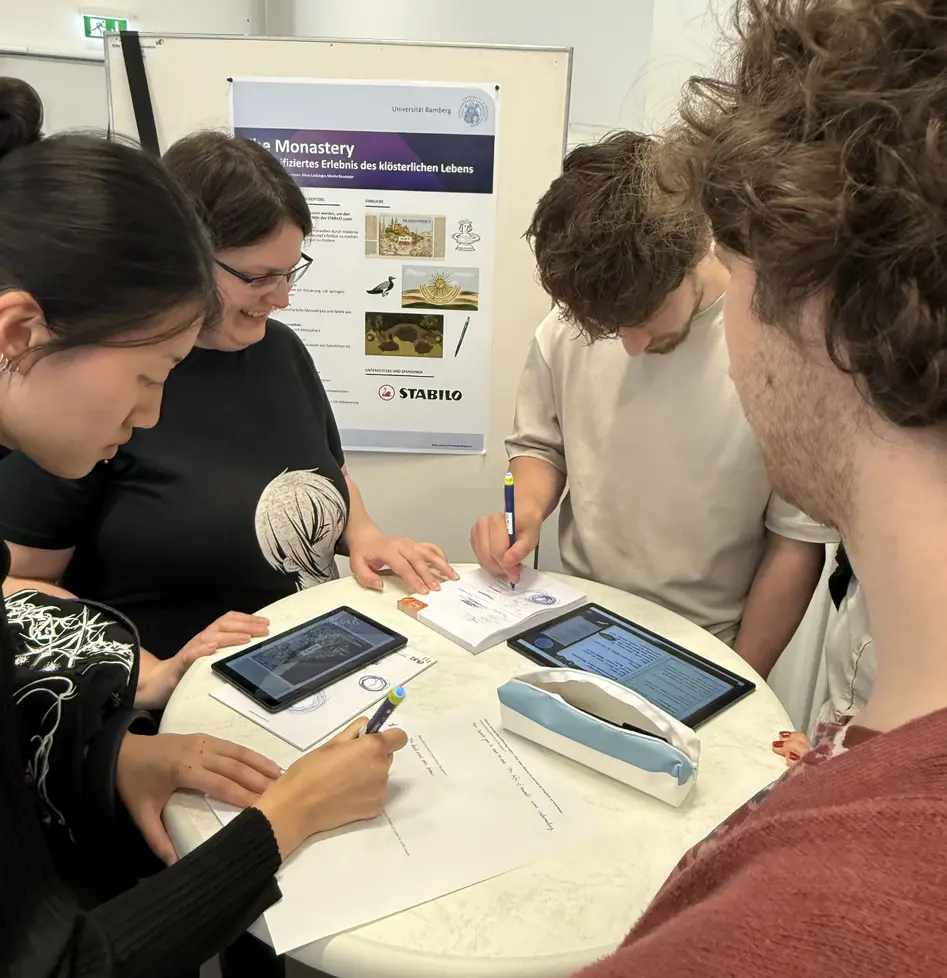
Pens have a long tradition in pen-and-paper games, yet they have so far found little application in digital games. With the new Lunis Pen, STABILO has introduced a digital pen that opens up new possibilities for interaction.
This raises the question: Can a digital pen like the STABILO Lunis Pen be used as an input device for digital games — and can it even provide a novel or improved gaming experience compared to typical input devices such as keyboard, mouse, or game controller? The goal of this project was therefore to develop a game in which the digital STABILO Lunis Pen is used as the primary input device in order to enable a novel, unique, and potentially superior gameplay experience.
Develop an innovative game concept (single player or multiplayer) in which a digital pen is used as an input device and players rate the experience of playing more positively than with typical input devices.
The Monastery
Team: Ian Glinsboeckel, Moritz Neumeier, Elena Laubinger, David Harutyunyan
Abstract:
The project “The Monastery” emerged from the creative task of developing an innovative application for the STABILO Lunis. Our team used this technological requirement as a starting point to create a solution for playfully conveying historical educational content. The pen’s haptic and motion-sensitive capabilities provided the ideal foundation for making learning content not only visually, but also physically tangible. The developed system addresses the challenge that abstract historical topics are often difficult for young learners to grasp, while simultaneously tackling issues related to writing anxiety. The guiding idea behind the concept was to explore how a gamified experience could make everyday life in a medieval monastery tangible through the pen. To achieve this, the design was grounded in established motivational theories. In particular, Self- Determination Theory (Deci & Ryan, 2000) served as a framework to strengthen intrinsic motivation by supporting autonomy and competence. Additionally, Flow Theory (Csikszentmihalyi, 1990) was applied to enable a state of deep immersion. The system combines an authentic medieval aesthetic with motivating game mechanics that are controlled through physical pen gestures such as shaking or tilting. An empirical evaluation with 18 participants confirmed the success of the concept and validated the underlying design decisions. Quantitative data showed high ratings for perceived autonomy (Ø 6.2/7) and sense of progress (Ø 6.3/7). The innovative pen-based interaction was rated as highly immersive, though somewhat unusual at first. Qualitative feedback supported these findings and additionally confirmed successful acquisition of knowledge about monastic life. In summary, “The Monastery” demonstrates how a technological requirement can serve as a starting point for creating a meaningful learning experience. The high intention to replay (Ø 5.8/7) and willingness to recommend (Ø 6.0/7) validate the chosen approach. The project highlights the significant potential that lies in combining physical interaction devices, gamification, and educational content for future digital learning technologies.