
Research projects in cooperation with STABILO
Designing a text-based adventure game to train an AI in reading handwriting
(Parts of this project were carried out by our team before we came to the Otto-Friedrich University of Bamberg).
In collaboration with STABILO International GmbH, we supported the development of the STABILO DigiPen, the further development of which has been available as the STABILO Lunis since 2025.
With the goal of collecting handwriting data from a large number of people, our research group developed a text-based adventure game during their time at FAU Erlangen-Nuremberg. STABILO Dungeon is a gamified crowdsourcing approach that aims to engage people in writing words with the IoT device Digipen, a classic ballpoint pen equipped with sensors to detect movement and pressure of a person’s handwriting. The aim of this project is to collect handwriting data for further developing the Digipen’s machine learning algorithms.
The core game mechanism of STABILO Dungeon is primarily driven by a narrative: At predefined points in the game, the player controlling the protagonist can decide the story’s progression by writing down an actionable activity on standard paper. The possible activities are a set of pre-defined actions in the game, which makes it easy for the DigiPen to recognise the handwritten word and thus to further train the handwriting recognition.
While the benefits and potential of gamification have been consistently demonstrated in various research, it is crucial to acknowledge that gamification approaches are not always effective and vary in their success, possibly because standard gamification concepts such as one-size-fits-all (OSFA) approaches commonly lack the consideration of the diversity of users. However, with adaptive gamification, this issue can be addressed by adapting the system to the individual user’s preferences.
Between January and May 2022, the experiment was presented on two consecutive weekends at JOSEPHS, an open-innovation laboratory in the city-centre of Nuremberg, as well as at the “Long Night of the Sciences” in Nuremberg. In total, the study resulted in a collection of 8,563 crowdsourced handwritten words. 135 participants completed the experiment by playing the game as well as filling out two questionnaires which measured the players’ enjoyment and intention for future play, amongst others.
The public-service radio and television broadcaster Bayerischer Rundfun released a short video in German showcasing the experiment as well as the DigiPen as part of the Frankenschau at 28.02.2022.
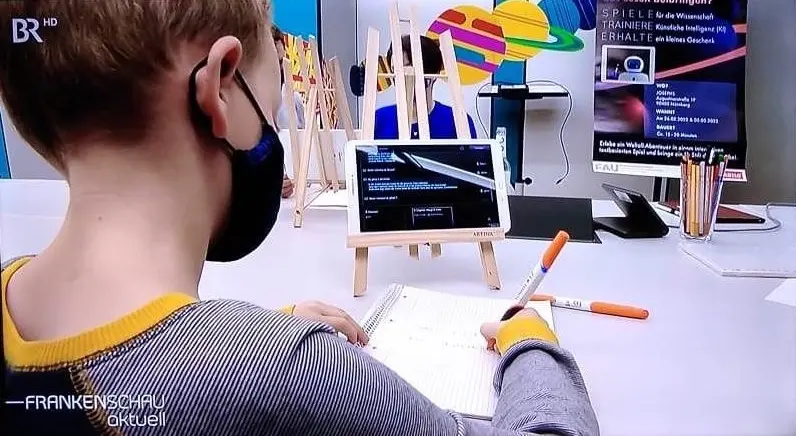
For more details, see: https://www.br.de/mediathek/video/erste-testlaeufe-intelligenter-stift-digitalisiert-handschrift-av:621d14290b569700085cde93
We thank Jens Barth, Tim Hamann and Peter Kaempf of STABILO International GmbH for the exciting collaboration.
The study was presented as a conference paper at the Hawaii International Conference on System Sciences 2023 in January 2023. Please see the paper for full details:
The Monastery – Game-based learning with the STABILO Lunis Pen
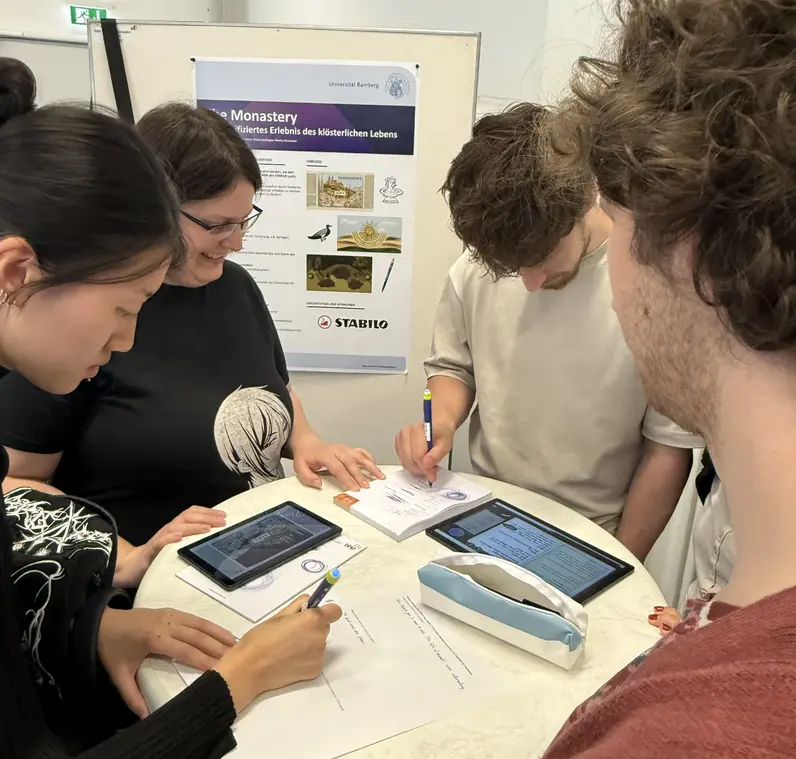
In cooperation with STABILO International GmbH, students of the Designing Gamified Systems lecture at the University of Bamberg developed an innovative, pen-centric game concept called The Monastery, which explores new forms of interaction and educational experiences with the STABILO Lunis Pen.
While digital pens have traditionally seen little use in digital games despite their long history in tabletop play, The Monastery investigates how the Lunis Pen can serve as a primary game input device and offer a distinctively engaging experience compared to conventional game controllers or keyboards.
The project centers on presenting historical educational content, specifically everyday life in a medieval monastery, through playful interaction. By leveraging the Lunis Pen’s haptic and motion-sensitive features, the game makes learning both visually and physically tangible and engaging.
Design decisions were grounded in established theories of motivation and engagement: Self-Determination Theory was used to strengthen autonomy and competence, and Flow Theory supported the creation of deeply immersive gameplay.
Players interact with the game through physical pen gestures such as shaking or tilting, which control core mechanics embedded within an authentic medieval aesthetic.